
'%3e%3crect%20width='32'%20height='24'%20fill='white'/%3e%3cpath%20fill-rule='evenodd'%20clip-rule='evenodd'%20d='M0%200V24H32V0H0Z'%20fill='%232E42A5'/%3e%3cmask%20id='mask0_270_67386'%20style='mask-type:luminance'%20maskUnits='userSpaceOnUse'%20x='0'%20y='0'%20width='32'%20height='24'%3e%3cpath%20fill-rule='evenodd'%20clip-rule='evenodd'%20d='M0%200V24H32V0H0Z'%20fill='white'/%3e%3c/mask%3e%3cg%20mask='url(%23mask0_270_67386)'%3e%3cpath%20d='M-3.56323%2022.2854L3.47846%2025.2635L32.1597%203.23787L35.874%20-1.18761L28.344%20-2.18297L16.6456%207.3085L7.22956%2013.7035L-3.56323%2022.2854Z'%20fill='white'/%3e%3cpath%20d='M-2.59924%2024.3719L0.988173%2026.1001L34.5402%20-1.59881H29.5031L-2.59924%2024.3719Z'%20fill='%23F50100'/%3e%3cpath%20d='M35.5631%2022.2854L28.5214%2025.2635L-0.159817%203.23787L-3.87415%20-1.18761L3.65593%20-2.18297L15.3543%207.3085L24.7703%2013.7035L35.5631%2022.2854Z'%20fill='white'/%3e%3cpath%20d='M35.3229%2023.7829L31.7355%2025.5111L17.4487%2013.6518L13.2129%2012.3267L-4.23151%20-1.17246H0.805637L18.2403%2012.0063L22.8713%2013.5952L35.3229%2023.7829Z'%20fill='%23F50100'/%3e%3cmask%20id='path-7-inside-1_270_67386'%20fill='white'%3e%3cpath%20fill-rule='evenodd'%20clip-rule='evenodd'%20d='M19.7777%20-2H12.2222V8H-1.97253V16H12.2222V26H19.7777V16H34.0275V8H19.7777V-2Z'/%3e%3c/mask%3e%3cpath%20fill-rule='evenodd'%20clip-rule='evenodd'%20d='M19.7777%20-2H12.2222V8H-1.97253V16H12.2222V26H19.7777V16H34.0275V8H19.7777V-2Z'%20fill='%23F50100'/%3e%3cpath%20d='M12.2222%20-2V-4H10.2222V-2H12.2222ZM19.7777%20-2H21.7777V-4H19.7777V-2ZM12.2222%208V10H14.2222V8H12.2222ZM-1.97253%208V6H-3.97253V8H-1.97253ZM-1.97253%2016H-3.97253V18H-1.97253V16ZM12.2222%2016H14.2222V14H12.2222V16ZM12.2222%2026H10.2222V28H12.2222V26ZM19.7777%2026V28H21.7777V26H19.7777ZM19.7777%2016V14H17.7777V16H19.7777ZM34.0275%2016V18H36.0275V16H34.0275ZM34.0275%208H36.0275V6H34.0275V8ZM19.7777%208H17.7777V10H19.7777V8ZM12.2222%200H19.7777V-4H12.2222V0ZM14.2222%208V-2H10.2222V8H14.2222ZM-1.97253%2010H12.2222V6H-1.97253V10ZM0.0274658%2016V8H-3.97253V16H0.0274658ZM12.2222%2014H-1.97253V18H12.2222V14ZM14.2222%2026V16H10.2222V26H14.2222ZM19.7777%2024H12.2222V28H19.7777V24ZM17.7777%2016V26H21.7777V16H17.7777ZM34.0275%2014H19.7777V18H34.0275V14ZM32.0275%208V16H36.0275V8H32.0275ZM19.7777%2010H34.0275V6H19.7777V10ZM17.7777%20-2V8H21.7777V-2H17.7777Z'%20fill='white'%20mask='url(%23path-7-inside-1_270_67386)'/%3e%3c/g%3e%3c/g%3e%3cdefs%3e%3cclipPath%20id='clip0_270_67386'%3e%3crect%20width='32'%20height='24'%20fill='white'/%3e%3c/clipPath%3e%3c/defs%3e%3c/svg%3e)
'%3e%3crect%20width='32'%20height='24'%20fill='white'/%3e%3cpath%20fill-rule='evenodd'%20clip-rule='evenodd'%20d='M0%2016H32V24H0V16Z'%20fill='%23FFD018'/%3e%3cpath%20fill-rule='evenodd'%20clip-rule='evenodd'%20d='M0%208H32V16H0V8Z'%20fill='%23E31D1C'/%3e%3cpath%20fill-rule='evenodd'%20clip-rule='evenodd'%20d='M0%200H32V8H0V0Z'%20fill='%23272727'/%3e%3c/g%3e%3cdefs%3e%3cclipPath%20id='clip0_270_67353'%3e%3crect%20width='32'%20height='24'%20fill='white'/%3e%3c/clipPath%3e%3c/defs%3e%3c/svg%3e)
'%3e%3crect%20width='32'%20height='24'%20fill='white'/%3e%3cpath%20fill-rule='evenodd'%20clip-rule='evenodd'%20d='M22%200H32V24H22V0Z'%20fill='%23F50100'/%3e%3cpath%20fill-rule='evenodd'%20clip-rule='evenodd'%20d='M0%200H12V24H0V0Z'%20fill='%232E42A5'/%3e%3cpath%20fill-rule='evenodd'%20clip-rule='evenodd'%20d='M10%200H22V24H10V0Z'%20fill='%23F7FCFF'/%3e%3c/g%3e%3cdefs%3e%3cclipPath%20id='clip0_270_67361'%3e%3crect%20width='32'%20height='24'%20fill='white'/%3e%3c/clipPath%3e%3c/defs%3e%3c/svg%3e)
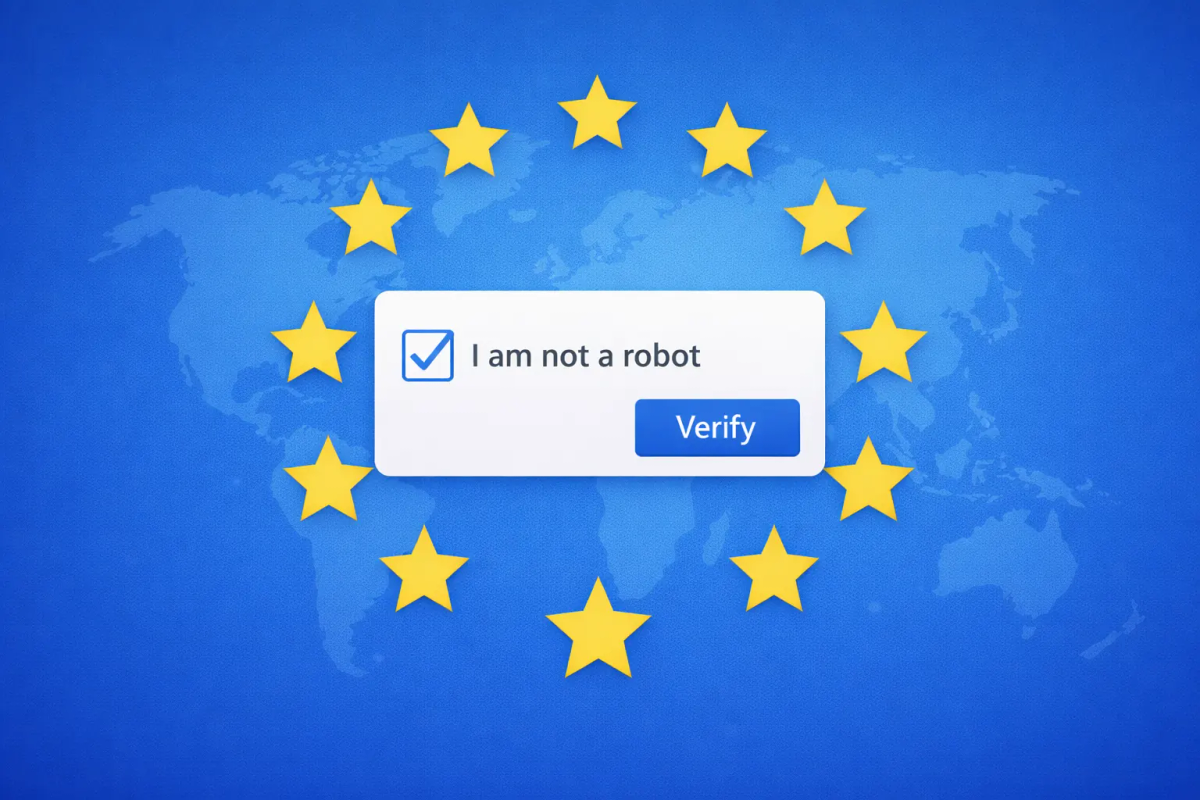
Why the Provider Location Matters for Privacy and Cybersecurity
For many website operators, CAPTCHAs are still treated as a simple technical add-on—something you drop into a signup form or checkout page to block bots. In today’s regulatory and threat landscape, that assumption no longer holds.
An EU CAPTCHA processes user interactions, network signals, and sometimes metadata that can be considered personal data. Where that data is processed, and under which legal jurisdiction the provider operates, may influence your overall privacy posture. For EU-focused businesses, the provider’s location can shape compliance risk, procurement decisions, and customer trust.
An EU-based CAPTCHA like TrustCaptcha is designed to address these questions upfront, aligning cybersecurity, privacy, and usability without adding interaction to legitimate users.
TrustCaptcha as a Leading EU CAPTCHA Service
TrustCaptcha is built for modern EU-focused websites that need reliable bot protection without compromising privacy, accessibility, or performance.
Use Cases
TrustCaptcha integrates seamlessly into common high-risk interaction points, including:
- Account sign-up and login pages
- Checkout and payment flows
- Contact and lead-generation forms
- Password reset and account recovery steps
These touchpoints are frequent targets for automated abuse, credential stuffing, and spam—yet they are also moments where user trust matters most.
EU-First Infrastructure and Deployment
TrustCaptcha is designed with EU-based servers and an EU-only deployment option, allowing organizations to keep CAPTCHA-related processing within the EU. This approach supports internal data-residency requirements and simplifies vendor assessments for EU-centric products.
With TrustCaptcha headquartered in the EU, operational control is under EU data-protection, without relying on complex international transfer mechanisms.
Privacy-by-Design Principles
TrustCaptcha follows a privacy-first approach that avoids unnecessary data collection. Depending on configuration and implementation, this includes:
- No third-party advertising cookies
- No cross-site tracking
- No persistent user identifiers that aren’t technically necessary
Transparency and Documentation
For compliance and procurement teams, TrustCaptcha provides:
- A clear privacy policy
- A standard Data Processing Agreement (DPA)
- Documentation on sub-processors and data flows
This transparency helps organizations evaluate risk and document decisions without guesswork.
Taken together, these elements position TrustCaptcha as a leading EU CAPTCHA built for security-conscious and privacy-aware teams.
How an EU CAPTCHA Impacts Cybersecurity and Data Protection
Choosing an EU CAPTCHA affects security and privacy on two distinct—but related—levels.
a) Physical Server and Sub-Processor Location
Where CAPTCHA traffic is processed matters. If user interaction data is routed through servers outside the EU, it may be subject to:
- Different surveillance laws
- Broader government access powers
- Additional transfer safeguards or assessments
An EU-hosted CAPTCHA like TrustCaptcha can limit cross-border data flows, reducing complexity in technical and legal reviews.
b) Company Jurisdiction and Control
Even if servers are physically located in Europe, the provider’s legal headquarters and jurisdiction also matter. Companies subject to non-EU laws may, in some cases, face obligations to provide access to data—even if stored abroad.
By operating under EU jurisdiction and using EU infrastructure, TrustCaptcha is designed to align both dimensions: location and legal control.
This dual alignment strengthens security architecture while supporting compliance-by-design.
EU CAPTCHA: Jurisdiction and Legal Exposure
GDPR in Brief
The General Data Protection Regulation (GDPR) establishes rules around:
- Lawful processing of personal data
- Transparency and user rights
- Restrictions on international data transfers
Any CAPTCHA solution used on EU-facing websites may fall within this scope, depending on how data is processed.
Why Non-EU Jurisdiction Can Increase Risk
Some non-EU CAPTCHA providers—particularly US-based ones—may be subject to laws such as:
- The US CLOUD Act, which can allow authorities to request access to data held by US companies
- FISA and National Security Letters, which may involve secrecy obligations
While these laws do not automatically mean data is accessed, they can introduce uncertainty for EU controllers trying to assess transfer risks.
Ongoing Transfer Uncertainty
Transatlantic data-transfer frameworks have evolved over time, and their interpretation continues to develop. As a result, some organizations prefer EU-only solutions to reduce dependency on external legal mechanisms.
TrustCaptcha is designed for teams that want to minimize these uncertainties through jurisdictional alignment rather than contractual complexity.
Data Sovereignty Explained
Data sovereignty means that data is subject to the laws and governance of the country—or region—where it is processed and controlled.
Importantly, “EU provider” alone is not enough if:
- Infrastructure is hosted outside the EU
- Key sub-processors operate under non-EU jurisdictions
- Operational control ultimately rests with a non-EU parent company
TrustCaptcha’s EU-focused approach addresses sovereignty holistically—combining infrastructure, operations, and governance within the EU wherever possible.
This helps organizations maintain clearer control over data flows and accountability.
Benefits of Prioritizing an EU CAPTCHA
Stronger Privacy Standards
EU-based providers typically operate within stricter privacy expectations, aligning product design with GDPR principles from the start.
Data Sovereignty and Control
EU-only deployment options help keep CAPTCHA-related data within EU borders, simplifying internal compliance reviews.
Reduced Exposure to Foreign Access Requests
By limiting reliance on non-EU jurisdictions, organizations may reduce exposure to foreign surveillance or access mechanisms.
Transparency and Documentation
Clear DPAs, privacy policies, and sub-processor disclosures make vendor risk assessments more efficient.
Digital Independence and Resilience
Choosing EU infrastructure supports long-term digital autonomy and reduces dependency on external legal regimes.
TrustCaptcha brings these benefits together in a single, production-ready EU CAPTCHA solution.
Conclusion: Why Opt for TrustCaptcha as a Leading EU CAPTCHA
For EU-focused businesses, CAPTCHA selection is no longer just a security decision—it is a privacy, compliance, and user-experience choice.
TrustCaptcha combines:
- EU-based infrastructure and jurisdiction
- Privacy-by-design architecture
- Accessible, friction-light user experience
- Clear documentation for compliance teams
Whether you are protecting signups, logins, or checkout flows, TrustCaptcha is designed to support security goals without compromising user trust or regulatory alignment. 👉 Start a free trial of TrustCaptcha to see how Trustcaptcha for yourself.