'%3e%3crect%20width='32'%20height='24'%20fill='white'/%3e%3cpath%20fill-rule='evenodd'%20clip-rule='evenodd'%20d='M0%200V24H32V0H0Z'%20fill='%232E42A5'/%3e%3cmask%20id='mask0_270_67386'%20style='mask-type:luminance'%20maskUnits='userSpaceOnUse'%20x='0'%20y='0'%20width='32'%20height='24'%3e%3cpath%20fill-rule='evenodd'%20clip-rule='evenodd'%20d='M0%200V24H32V0H0Z'%20fill='white'/%3e%3c/mask%3e%3cg%20mask='url(%23mask0_270_67386)'%3e%3cpath%20d='M-3.56323%2022.2854L3.47846%2025.2635L32.1597%203.23787L35.874%20-1.18761L28.344%20-2.18297L16.6456%207.3085L7.22956%2013.7035L-3.56323%2022.2854Z'%20fill='white'/%3e%3cpath%20d='M-2.59924%2024.3719L0.988173%2026.1001L34.5402%20-1.59881H29.5031L-2.59924%2024.3719Z'%20fill='%23F50100'/%3e%3cpath%20d='M35.5631%2022.2854L28.5214%2025.2635L-0.159817%203.23787L-3.87415%20-1.18761L3.65593%20-2.18297L15.3543%207.3085L24.7703%2013.7035L35.5631%2022.2854Z'%20fill='white'/%3e%3cpath%20d='M35.3229%2023.7829L31.7355%2025.5111L17.4487%2013.6518L13.2129%2012.3267L-4.23151%20-1.17246H0.805637L18.2403%2012.0063L22.8713%2013.5952L35.3229%2023.7829Z'%20fill='%23F50100'/%3e%3cmask%20id='path-7-inside-1_270_67386'%20fill='white'%3e%3cpath%20fill-rule='evenodd'%20clip-rule='evenodd'%20d='M19.7777%20-2H12.2222V8H-1.97253V16H12.2222V26H19.7777V16H34.0275V8H19.7777V-2Z'/%3e%3c/mask%3e%3cpath%20fill-rule='evenodd'%20clip-rule='evenodd'%20d='M19.7777%20-2H12.2222V8H-1.97253V16H12.2222V26H19.7777V16H34.0275V8H19.7777V-2Z'%20fill='%23F50100'/%3e%3cpath%20d='M12.2222%20-2V-4H10.2222V-2H12.2222ZM19.7777%20-2H21.7777V-4H19.7777V-2ZM12.2222%208V10H14.2222V8H12.2222ZM-1.97253%208V6H-3.97253V8H-1.97253ZM-1.97253%2016H-3.97253V18H-1.97253V16ZM12.2222%2016H14.2222V14H12.2222V16ZM12.2222%2026H10.2222V28H12.2222V26ZM19.7777%2026V28H21.7777V26H19.7777ZM19.7777%2016V14H17.7777V16H19.7777ZM34.0275%2016V18H36.0275V16H34.0275ZM34.0275%208H36.0275V6H34.0275V8ZM19.7777%208H17.7777V10H19.7777V8ZM12.2222%200H19.7777V-4H12.2222V0ZM14.2222%208V-2H10.2222V8H14.2222ZM-1.97253%2010H12.2222V6H-1.97253V10ZM0.0274658%2016V8H-3.97253V16H0.0274658ZM12.2222%2014H-1.97253V18H12.2222V14ZM14.2222%2026V16H10.2222V26H14.2222ZM19.7777%2024H12.2222V28H19.7777V24ZM17.7777%2016V26H21.7777V16H17.7777ZM34.0275%2014H19.7777V18H34.0275V14ZM32.0275%208V16H36.0275V8H32.0275ZM19.7777%2010H34.0275V6H19.7777V10ZM17.7777%20-2V8H21.7777V-2H17.7777Z'%20fill='white'%20mask='url(%23path-7-inside-1_270_67386)'/%3e%3c/g%3e%3c/g%3e%3cdefs%3e%3cclipPath%20id='clip0_270_67386'%3e%3crect%20width='32'%20height='24'%20fill='white'/%3e%3c/clipPath%3e%3c/defs%3e%3c/svg%3e)
'%3e%3crect%20width='32'%20height='24'%20fill='white'/%3e%3cpath%20fill-rule='evenodd'%20clip-rule='evenodd'%20d='M0%2016H32V24H0V16Z'%20fill='%23FFD018'/%3e%3cpath%20fill-rule='evenodd'%20clip-rule='evenodd'%20d='M0%208H32V16H0V8Z'%20fill='%23E31D1C'/%3e%3cpath%20fill-rule='evenodd'%20clip-rule='evenodd'%20d='M0%200H32V8H0V0Z'%20fill='%23272727'/%3e%3c/g%3e%3cdefs%3e%3cclipPath%20id='clip0_270_67353'%3e%3crect%20width='32'%20height='24'%20fill='white'/%3e%3c/clipPath%3e%3c/defs%3e%3c/svg%3e)
'%3e%3crect%20width='32'%20height='24'%20fill='white'/%3e%3cpath%20fill-rule='evenodd'%20clip-rule='evenodd'%20d='M22%200H32V24H22V0Z'%20fill='%23F50100'/%3e%3cpath%20fill-rule='evenodd'%20clip-rule='evenodd'%20d='M0%200H12V24H0V0Z'%20fill='%232E42A5'/%3e%3cpath%20fill-rule='evenodd'%20clip-rule='evenodd'%20d='M10%200H22V24H10V0Z'%20fill='%23F7FCFF'/%3e%3c/g%3e%3cdefs%3e%3cclipPath%20id='clip0_270_67361'%3e%3crect%20width='32'%20height='24'%20fill='white'/%3e%3c/clipPath%3e%3c/defs%3e%3c/svg%3e)
Visual CAPTCHAs were built on one assumption: bots can’t interpret images the way humans do. For a while, that was roughly true. It isn’t anymore. Today, bypassing a CAPTCHA is a documented, low-cost operation — accessible to anyone willing to spend a few dollars per thousand requests. Understanding how it happens, and what protection actually holds, is now the more useful question.
Why Visual CAPTCHAs Are Easy Targets
Traditional CAPTCHAs present a visual challenge: read distorted text, identify all traffic lights, drag a puzzle piece. The logic was that computers couldn’t reliably interpret ambiguous images while humans could. Knowing how CAPTCHAs work at the mechanism level shows where that assumption breaks down.
Computer vision models now achieve higher accuracy than humans on many image classification tasks, including the challenge types used in CAPTCHA systems. The W3C Inaccessibility of CAPTCHA note has flagged reliability and accessibility problems with visual challenges since 2005. The gap between human and machine performance on recognition tasks has only narrowed since then.
When a CAPTCHA relies purely on recognition, there are two ways a bot can beat it: automate the recognition itself, or pay a human to do it. Both are well-established.
How Bots Bypass CAPTCHAs
Automation Frameworks: Selenium, Playwright, and Headless Browsers
Selenium and Playwright are browser automation tools built for testing web applications. They control real browsers — Chrome, Firefox, Edge — execute JavaScript, handle cookies, and interact with page elements exactly as a human would. When a bot runs through Playwright, it sends real browser headers, loads full page resources, and fires click events at the right coordinates.
A CAPTCHA that checks whether a user clicked a checkbox doesn’t distinguish a human click from an automated one. The browser is real. The interaction is real.
Headless browsers take this further. Chrome Headless runs without a visible window, faster and more scalable, making it practical to run thousands of automated sessions in parallel with minimal infrastructure cost.
CAPTCHA Solving Services
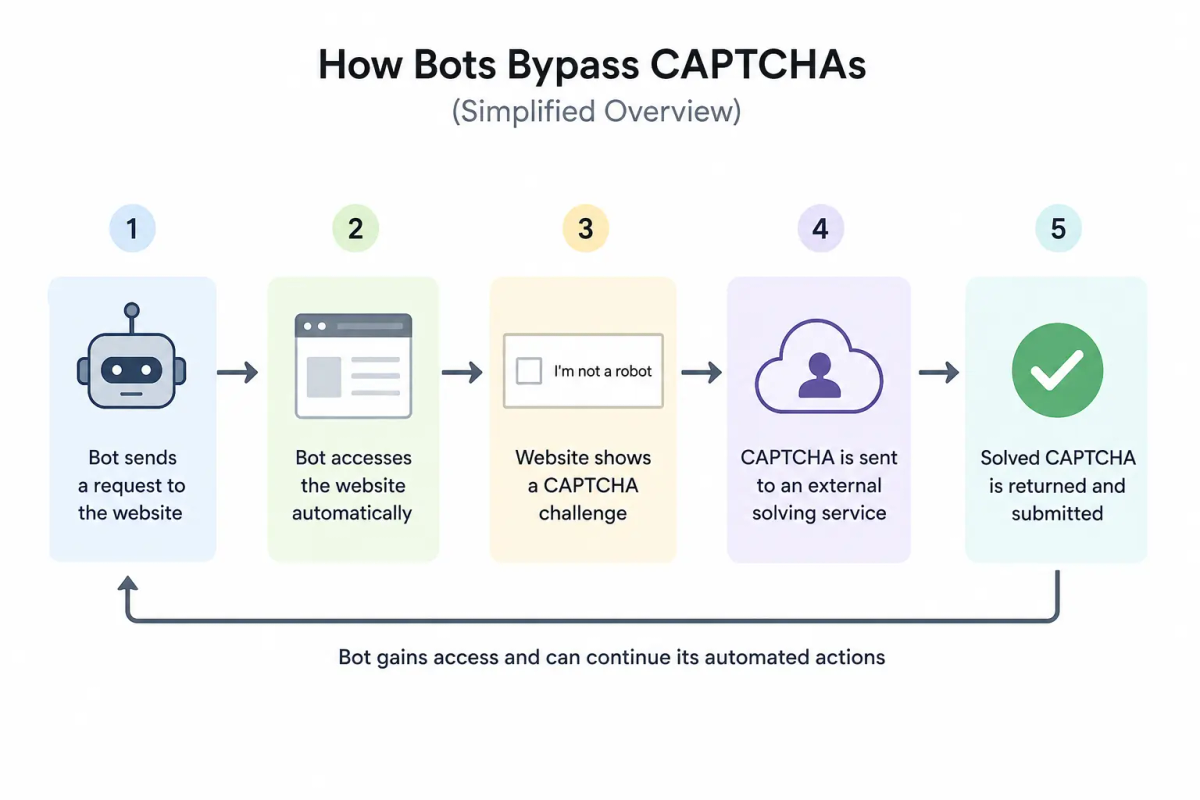
When automation alone isn’t enough to interpret the visual challenge, bots route it to a solving service. Two main models exist.
Human-powered farms hire workers to solve CAPTCHAs via API. The bot submits the challenge image; a worker solves it within seconds; the valid token comes back. Pricing runs roughly $1–3 per thousand solutions. For high-value targets — account registrations, ticket purchases, credential operations — this cost is negligible.
AI-based solvers train neural networks on CAPTCHA challenge data. They run locally, carry only minimal per-request cost, and handle most text-based challenges with near-complete accuracy. Image challenges vary by type, but the performance gap with humans is narrowing across all of them.
The Recognition Arms Race
There’s a pattern in how image CAPTCHA difficulty has evolved: challenges get harder, solvers get better, and legitimate users absorb most of the friction. Math CAPTCHAs illustrate this trajectory well — when they were introduced, they seemed like a reasonable simplification of the visual challenge format. Today, they are trivially solved by any basic automation script. More complex image challenges take longer to beat, but each version is eventually cracked as models accumulate challenge data.
Why Recognition-Based Challenges Don’t Hold Up
The structural problem isn’t that CAPTCHA designers aren’t clever enough. It’s that recognition is the wrong test. Any task that can be described precisely enough to train a machine on will eventually be automatable. That applies to every visual challenge ever deployed in a CAPTCHA.
Making challenges harder doesn’t fix this — it delays it. And harder challenges impose real costs on users with visual or cognitive disabilities, while bot operators wait for improved models.
Rate limiting and IP blocking add some protection at the margins. Bots running through Playwright at human-paced timing avoid simple rate triggers. Sophisticated operations rotate IPs across residential proxy networks. These measures reduce volume; they don’t resolve intent.
What Actually Works: A Layered Defense
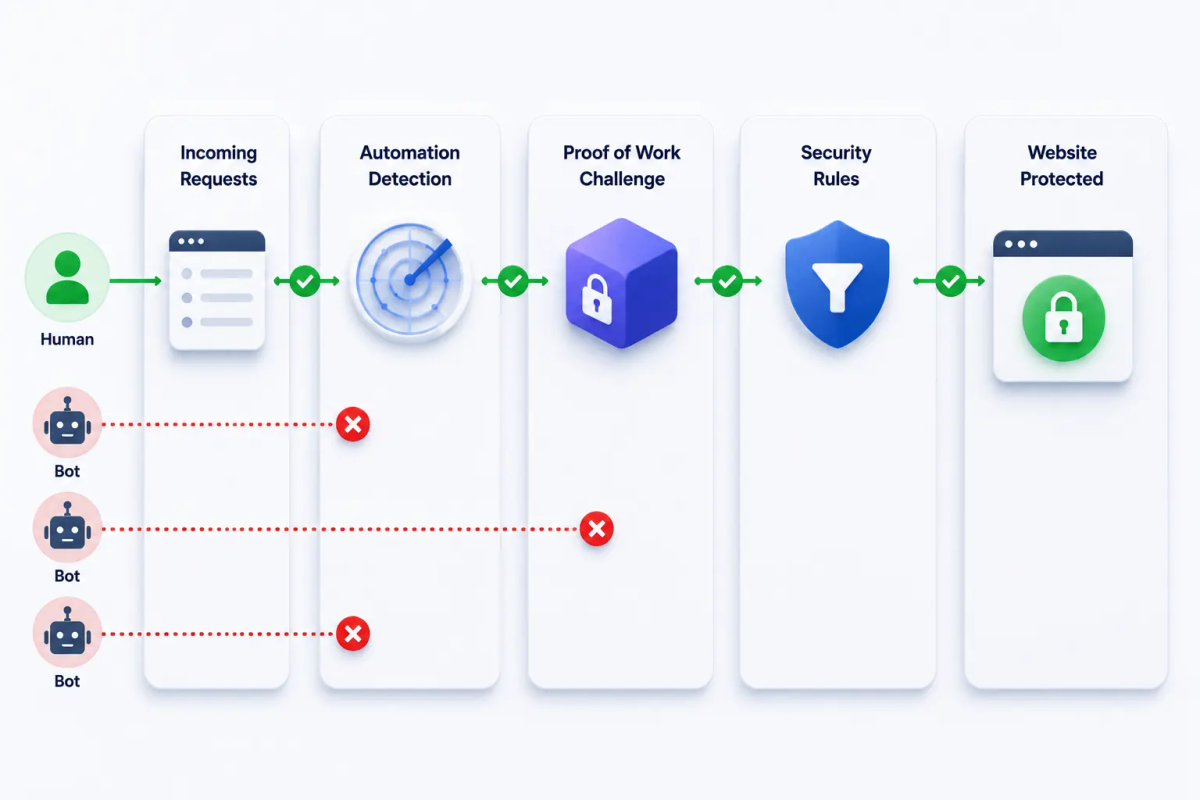
Protection that holds against modern CAPTCHA bypass doesn’t replace one recognition test with a harder one. It adds a layer that doesn’t depend on recognition at all.
Bot Signal Detection
Browser and behavioral signals can identify automated traffic in many cases. Bot scoring systems that evaluate these signals can flag suspicious requests before any challenge is even presented.
This layer already stops a large percentage of bots and spam. More sophisticated operations are specifically built to blend past signal-based detection — which is why a second layer is necessary.
Proof of Work: The Layer That Can’t Be Outsourced
Proof of Work asks the browser to compute something rather than recognize something. The challenge is cryptographic — a hash computation that requires real CPU time. A legitimate user’s browser completes it in the background, invisibly. The user notices nothing.
For a single request, the cost is negligible. For a bot operation running thousands of concurrent sessions, the aggregate computation becomes real. Unlike image recognition, computation cannot be delegated to a human solving farm — workers can’t solve hashes, only algorithms can. And unlike AI image solvers, there’s no training shortcut. The work simply has to happen.
When elevated risk signals appear, Proof-of-Work difficulty scales up automatically. Low-risk traffic passes quickly; suspicious traffic gets a harder challenge. Real users are never affected because the computation runs without interrupting them.
This is what separates Proof of Work from recognition-based approaches: the cost to the attacker scales with scale. Image CAPTCHAs get cheaper to bypass as models improve. Proof of Work doesn’t.
TrustCaptcha: Three Layers Working Together
TrustCaptcha runs both mechanisms in sequence. Every request is scored against browser and behavioral signals. For real users, the Proof-of-Work challenge runs invisibly in the background. For requests with elevated risk signals, challenge difficulty increases automatically.
There’s no image to route to a solving farm. There’s no checkbox a Playwright script can click through. The bot detection features handle the first filter; Proof of Work handles the rest. A bot that evades one layer still hits the other.
On top of both, TrustCaptcha supports custom security rules — allowing site operators to define granular, situation-specific conditions that trigger additional action. Rules can target specific endpoints, traffic patterns, or risk thresholds, giving teams direct control over how protection behaves in their particular context without relying solely on automated scoring.
For sites evaluating modern CAPTCHA alternatives without Google dependency or GDPR exposure, TrustCaptcha runs on EU-only infrastructure and stores no cookies. A Data Processing Agreement is included with every plan — no separate legal negotiations required.
Key Takeaways
- Visual CAPTCHAs can be bypassed reliably using browser automation frameworks like Selenium or Playwright, or through CAPTCHA solving services priced below $3 per thousand challenges.
- Making image challenges harder primarily affects legitimate users. It doesn’t fix the underlying problem that recognition tasks are increasingly automatable.
- Bot signal detection already stops a large percentage of bots and spam. More sophisticated operations are built to blend past it — making a second layer necessary.
- Proof of Work is the layer that holds when detection fails. It requires real computation that can’t be farmed out to humans or solved faster by AI.
- A CAPTCHA like TrustCaptcha that combines bot signal detection, Proof of Work, and custom security rules can reliably block bypass attempts — regardless of whether the attack relies on automation, solving services, or advanced evasion, at least one layer applies.
Try TrustCaptcha for Free
Your users shouldn’t have to solve puzzles to prove they’re human — and you shouldn’t have to choose between a smooth experience and reliable protection. Try TrustCaptcha for free: invisible verification that real users never notice, no interaction required, and bot protection that holds up against modern bypass attempts.