

'%3e%3crect%20width='32'%20height='24'%20fill='white'/%3e%3cpath%20fill-rule='evenodd'%20clip-rule='evenodd'%20d='M0%200V24H32V0H0Z'%20fill='%232E42A5'/%3e%3cmask%20id='mask0_270_67386'%20style='mask-type:luminance'%20maskUnits='userSpaceOnUse'%20x='0'%20y='0'%20width='32'%20height='24'%3e%3cpath%20fill-rule='evenodd'%20clip-rule='evenodd'%20d='M0%200V24H32V0H0Z'%20fill='white'/%3e%3c/mask%3e%3cg%20mask='url(%23mask0_270_67386)'%3e%3cpath%20d='M-3.56323%2022.2854L3.47846%2025.2635L32.1597%203.23787L35.874%20-1.18761L28.344%20-2.18297L16.6456%207.3085L7.22956%2013.7035L-3.56323%2022.2854Z'%20fill='white'/%3e%3cpath%20d='M-2.59924%2024.3719L0.988173%2026.1001L34.5402%20-1.59881H29.5031L-2.59924%2024.3719Z'%20fill='%23F50100'/%3e%3cpath%20d='M35.5631%2022.2854L28.5214%2025.2635L-0.159817%203.23787L-3.87415%20-1.18761L3.65593%20-2.18297L15.3543%207.3085L24.7703%2013.7035L35.5631%2022.2854Z'%20fill='white'/%3e%3cpath%20d='M35.3229%2023.7829L31.7355%2025.5111L17.4487%2013.6518L13.2129%2012.3267L-4.23151%20-1.17246H0.805637L18.2403%2012.0063L22.8713%2013.5952L35.3229%2023.7829Z'%20fill='%23F50100'/%3e%3cmask%20id='path-7-inside-1_270_67386'%20fill='white'%3e%3cpath%20fill-rule='evenodd'%20clip-rule='evenodd'%20d='M19.7777%20-2H12.2222V8H-1.97253V16H12.2222V26H19.7777V16H34.0275V8H19.7777V-2Z'/%3e%3c/mask%3e%3cpath%20fill-rule='evenodd'%20clip-rule='evenodd'%20d='M19.7777%20-2H12.2222V8H-1.97253V16H12.2222V26H19.7777V16H34.0275V8H19.7777V-2Z'%20fill='%23F50100'/%3e%3cpath%20d='M12.2222%20-2V-4H10.2222V-2H12.2222ZM19.7777%20-2H21.7777V-4H19.7777V-2ZM12.2222%208V10H14.2222V8H12.2222ZM-1.97253%208V6H-3.97253V8H-1.97253ZM-1.97253%2016H-3.97253V18H-1.97253V16ZM12.2222%2016H14.2222V14H12.2222V16ZM12.2222%2026H10.2222V28H12.2222V26ZM19.7777%2026V28H21.7777V26H19.7777ZM19.7777%2016V14H17.7777V16H19.7777ZM34.0275%2016V18H36.0275V16H34.0275ZM34.0275%208H36.0275V6H34.0275V8ZM19.7777%208H17.7777V10H19.7777V8ZM12.2222%200H19.7777V-4H12.2222V0ZM14.2222%208V-2H10.2222V8H14.2222ZM-1.97253%2010H12.2222V6H-1.97253V10ZM0.0274658%2016V8H-3.97253V16H0.0274658ZM12.2222%2014H-1.97253V18H12.2222V14ZM14.2222%2026V16H10.2222V26H14.2222ZM19.7777%2024H12.2222V28H19.7777V24ZM17.7777%2016V26H21.7777V16H17.7777ZM34.0275%2014H19.7777V18H34.0275V14ZM32.0275%208V16H36.0275V8H32.0275ZM19.7777%2010H34.0275V6H19.7777V10ZM17.7777%20-2V8H21.7777V-2H17.7777Z'%20fill='white'%20mask='url(%23path-7-inside-1_270_67386)'/%3e%3c/g%3e%3c/g%3e%3cdefs%3e%3cclipPath%20id='clip0_270_67386'%3e%3crect%20width='32'%20height='24'%20fill='white'/%3e%3c/clipPath%3e%3c/defs%3e%3c/svg%3e)
'%3e%3crect%20width='32'%20height='24'%20fill='white'/%3e%3cpath%20fill-rule='evenodd'%20clip-rule='evenodd'%20d='M0%2016H32V24H0V16Z'%20fill='%23FFD018'/%3e%3cpath%20fill-rule='evenodd'%20clip-rule='evenodd'%20d='M0%208H32V16H0V8Z'%20fill='%23E31D1C'/%3e%3cpath%20fill-rule='evenodd'%20clip-rule='evenodd'%20d='M0%200H32V8H0V0Z'%20fill='%23272727'/%3e%3c/g%3e%3cdefs%3e%3cclipPath%20id='clip0_270_67353'%3e%3crect%20width='32'%20height='24'%20fill='white'/%3e%3c/clipPath%3e%3c/defs%3e%3c/svg%3e)
'%3e%3crect%20width='32'%20height='24'%20fill='white'/%3e%3cpath%20fill-rule='evenodd'%20clip-rule='evenodd'%20d='M22%200H32V24H22V0Z'%20fill='%23F50100'/%3e%3cpath%20fill-rule='evenodd'%20clip-rule='evenodd'%20d='M0%200H12V24H0V0Z'%20fill='%232E42A5'/%3e%3cpath%20fill-rule='evenodd'%20clip-rule='evenodd'%20d='M10%200H22V24H10V0Z'%20fill='%23F7FCFF'/%3e%3c/g%3e%3cdefs%3e%3cclipPath%20id='clip0_270_67361'%3e%3crect%20width='32'%20height='24'%20fill='white'/%3e%3c/clipPath%3e%3c/defs%3e%3c/svg%3e)
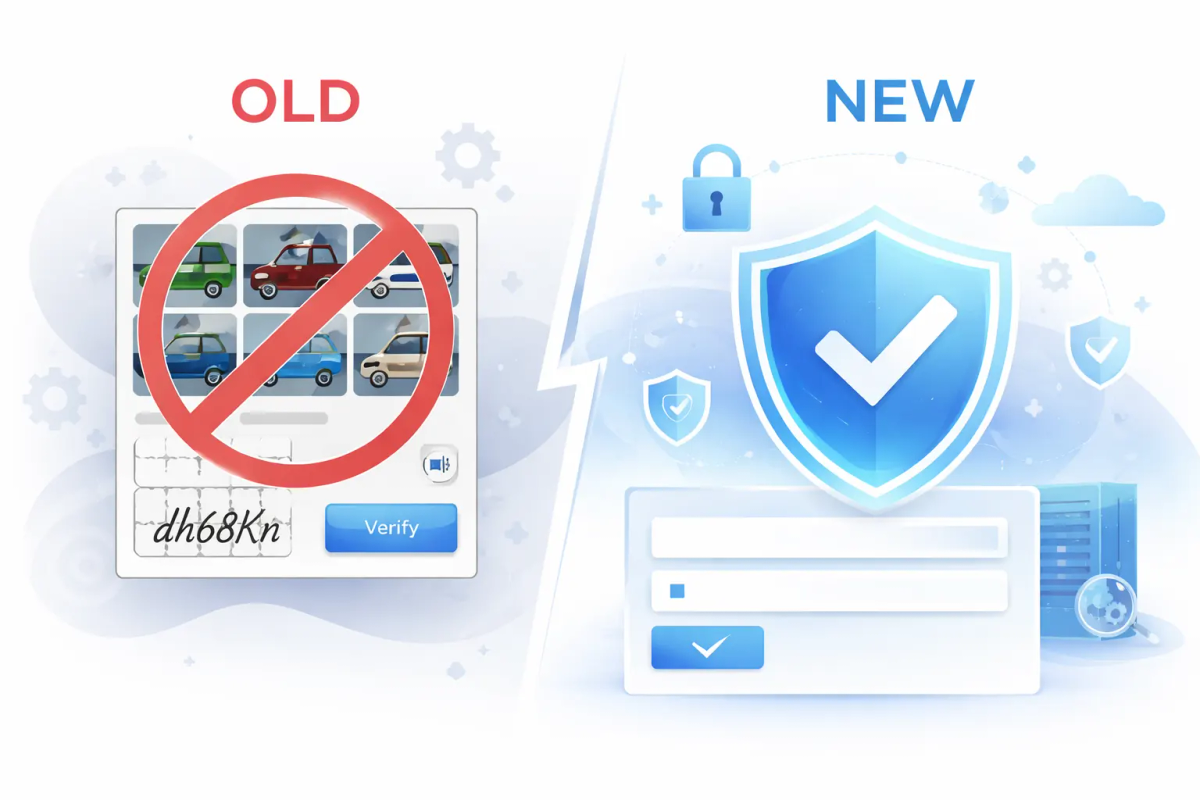
Businesses are rethinking CAPTCHA because the old model (interrupt users, force a challenge, then let them proceed) no longer fits how modern digital services are built and used. In 2026, the best CAPTCHA alternative is not defined by how difficult the puzzle is. It is defined by how reliably it reduces automated abuse while preserving privacy, accessibility, and a smooth user journey.
This guide explains why legacy CAPTCHAs are being replaced, what modern invisible approaches look like in practice, and why TrustCaptcha is designed as an invisible, no-interaction CAPTCHA for teams that want strong bot resistance without frustrating legitimate customers.
Short Summary
For most organisations, CAPTCHA has shifted from a purely technical control to a full business decision that affects conversion, customer satisfaction, compliance posture, and accessibility outcomes. Legacy puzzle CAPTCHAs introduce unnecessary interaction at high-stakes moments such as login, registration, checkout, and form submission, which can lead to avoidable drop-offs. At the same time, attackers have operationalised CAPTCHA bypass at scale through outsourced solving and automated tooling, which means visible challenges may deliver less security value than teams assume.
The emerging standard is invisible verification: background checks that protect workflows without demanding user interaction. TrustCaptcha follows this direction by providing no-interaction verification designed to keep legitimate users in flow while raising the cost of automation, supporting privacy-first deployment expectations, and reducing the accessibility barriers associated with image, text, and audio challenges.
Why Traditional CAPTCHAs Are Being Replaced
CAPTCHA is not inherently flawed. The problem is the outdated implementation pattern that relies on user-facing puzzles as the primary defence. The internet environment has changed. Users have less patience for interruptions, businesses measure every point of friction, and bots have become more distributed, more professional, and more economically driven.
From a business perspective, traditional CAPTCHAs often behave like a conversion tax. They add an extra step at the moment when a user is most motivated to complete an action. Even when a user succeeds, the experience can feel punitive, confusing, or random. From a security perspective, puzzle challenges are frequently treated as a “gate,” but gates can be bypassed—especially when attackers can outsource solving cheaply or automate around challenge patterns.
From a governance perspective, the evaluation of bot protection now extends beyond security teams. Legal, privacy, and accessibility stakeholders increasingly need reassurance that the solution is purpose-limited, data-minimised, and inclusive by design, especially when third-party scripts and opaque processing are involved.
What “Best CAPTCHA Alternative” Means in 2026
In 2026, “best” is not a brand claim; it is a set of criteria. A modern alternative is expected to protect users and services without forcing legitimate users to act like security analysts.
A best-in-class solution is invisible by default and verifiable by design. Invisible means real users are not blocked by puzzles and can complete their tasks without interruption. Verifiable means your server still receives an enforceable outcome that can be checked and used to make a policy decision. This is important because client-side-only protection can be bypassed by attackers who never render your UI.
A modern solution should also deliver high signal with low data. That typically means minimising persistent identifiers, limiting retention to what is necessary for security operations, and avoiding cross-site tracking profiles. For many organisations, these design choices reduce compliance complexity and increase user trust.
Finally, the best alternative works across real-world environments. That includes mobile networks, high-latency conditions, corporate proxies, shared IPs, privacy tools, and assistive technologies. If a solution only works well for “typical” users, it may quietly create support burdens and exclusion at the edges.
Modern Approaches Explained: What Actually Works
Most CAPTCHA alternatives on the market can be understood through three technical approaches: risk scoring, proof-of-work, and hybrid models. Each has strengths and tradeoffs, and the best business outcomes usually come from combining approaches rather than relying on a single mechanism.
Risk scoring attempts to estimate whether an interaction is likely human or automated based on patterns and signals observed during the request. Its main advantage is that most users are not interrupted. However, risk scoring can produce false positives, particularly for users behind VPNs, corporate networks, or certain assistive technology setups. Depending on the implementation, risk scoring can also create privacy concerns if it relies on persistent tracking techniques that extend beyond what is necessary for abuse prevention.
Proof-of-work introduces an economic barrier to automation by requiring computational effort that is cheap for a single legitimate interaction but expensive when repeated at scale. It is compelling because it can be invisible to users and can reduce reliance on deep behavioural tracking. On its own, proof-of-work is not always sufficient against advanced adversaries, but it is a strong building block when combined with other signals and server-side policy.
Hybrid models combine background verification with risk signals and enforcement controls. This approach tends to reduce blind spots: proof-of-work raises the cost of scale, risk signals help tune decisions, and server-side policies allow your organisation to enforce nuanced outcomes rather than binary pass/fail gates.
Why TrustCaptcha Is a Best CAPTCHA Alternative
TrustCaptcha is designed as an invisible, no-interaction CAPTCHA that protects your workflows without puzzles, image grids, distorted text, or checkbox steps. The core objective is to keep legitimate users moving while making automated abuse more difficult and more costly.
No-interaction verification matters because most business risk is concentrated in a few high-value flows—login, signup, password reset, checkout, and critical forms. These flows are where friction causes the most damage and where attackers often focus. TrustCaptcha is positioned to protect those moments without forcing users into repetitive challenges or confusing verification screens.
TrustCaptcha is also designed with a privacy-first posture. That means it is intended to operate without its own cookies and without creating cross-site tracking profiles. For many businesses, this posture is not just a preference; it is a procurement requirement. It reduces the compliance surface area and helps align bot protection with purpose-limited security processing rather than marketing-style tracking patterns.
From an accessibility perspective, the best improvement is often removing the challenge entirely. Traditional CAPTCHAs can create barriers for users who cannot easily solve visual or audio tests, or who struggle with precise interaction under time pressure. By eliminating the puzzle step, TrustCaptcha aims to reduce those barriers and support a more inclusive experience.
Integration Guide for Businesses
Most organisations should begin by protecting endpoints that attract automated abuse and have high impact: login, signup, password reset, checkout, contact forms, account recovery flows, and API endpoints that face scraping or credential stuffing. This targeted approach avoids unnecessary processing and concentrates protection where it reduces the most risk.
A scalable architecture typically follows a client-plus-server verification pattern. The client initiates background verification and attaches a verification outcome to the protected request. Your server then verifies the outcome and applies policy. This matters because server-side verification is enforceable. If a check only exists in the browser, attackers can bypass it by calling your endpoints directly.
Operationally, you should define how your application behaves during failures and edge cases. Some endpoints can tolerate fail-open behaviour to protect conversion, while others should fail-closed to protect account security. You should also instrument the deployment so you can measure pass rates, enforcement rates, friction indicators, and false positives. Bot protection is not a “set and forget” control; it is a system that benefits from monitoring and tuning.
Migration Plan From Legacy CAPTCHA Providers
Migrating from reCAPTCHA or a puzzle-based CAPTCHA is safest when it is staged. A shadow-mode rollout allows you to measure how TrustCaptcha performs on real traffic without enforcing blocks. That gives your team baseline metrics and helps identify edge cases before they affect customers.
After shadow mode, many organisations move to soft enforcement, where only the highest-confidence abusive interactions are blocked while borderline cases follow a step-up or alternative handling path. Once you have confidence and monitoring in place, you can expand coverage and tighten policies over time.
The metrics that matter are not limited to “bots blocked.” You should also track conversion rates on protected flows, completion times, user complaints, support tickets related to verification, and operational load from spam and abuse. The ideal outcome is that security improves while customer friction decreases.
Conclusion
In 2026, traditional puzzle CAPTCHAs increasingly fail the modern standard: they frustrate legitimate users, create accessibility barriers, and provide diminishing security value against industrialised bot operations. The best CAPTCHA alternative is one that protects high-value workflows invisibly, with verifiable enforcement and a privacy-first approach that organisations can confidently deploy.
TrustCaptcha is built for that reality. It is an invisible, no-interaction CAPTCHA designed to reduce friction while strengthening defences against automated abuse. If you want to replace puzzles with a smoother, more modern verification layer, TrustCaptcha provides a practical path for business integration and long-term security outcomes.
If you’re ready to upgrade your bot protection, start by deploying TrustCaptcha on your highest-risk endpoints—login, signup, password reset, checkout—and measure the impact. Book a demo or begin your TrustCaptcha integration today.