
'%3e%3crect%20width='32'%20height='24'%20fill='white'/%3e%3cpath%20fill-rule='evenodd'%20clip-rule='evenodd'%20d='M0%200V24H32V0H0Z'%20fill='%232E42A5'/%3e%3cmask%20id='mask0_270_67386'%20style='mask-type:luminance'%20maskUnits='userSpaceOnUse'%20x='0'%20y='0'%20width='32'%20height='24'%3e%3cpath%20fill-rule='evenodd'%20clip-rule='evenodd'%20d='M0%200V24H32V0H0Z'%20fill='white'/%3e%3c/mask%3e%3cg%20mask='url(%23mask0_270_67386)'%3e%3cpath%20d='M-3.56323%2022.2854L3.47846%2025.2635L32.1597%203.23787L35.874%20-1.18761L28.344%20-2.18297L16.6456%207.3085L7.22956%2013.7035L-3.56323%2022.2854Z'%20fill='white'/%3e%3cpath%20d='M-2.59924%2024.3719L0.988173%2026.1001L34.5402%20-1.59881H29.5031L-2.59924%2024.3719Z'%20fill='%23F50100'/%3e%3cpath%20d='M35.5631%2022.2854L28.5214%2025.2635L-0.159817%203.23787L-3.87415%20-1.18761L3.65593%20-2.18297L15.3543%207.3085L24.7703%2013.7035L35.5631%2022.2854Z'%20fill='white'/%3e%3cpath%20d='M35.3229%2023.7829L31.7355%2025.5111L17.4487%2013.6518L13.2129%2012.3267L-4.23151%20-1.17246H0.805637L18.2403%2012.0063L22.8713%2013.5952L35.3229%2023.7829Z'%20fill='%23F50100'/%3e%3cmask%20id='path-7-inside-1_270_67386'%20fill='white'%3e%3cpath%20fill-rule='evenodd'%20clip-rule='evenodd'%20d='M19.7777%20-2H12.2222V8H-1.97253V16H12.2222V26H19.7777V16H34.0275V8H19.7777V-2Z'/%3e%3c/mask%3e%3cpath%20fill-rule='evenodd'%20clip-rule='evenodd'%20d='M19.7777%20-2H12.2222V8H-1.97253V16H12.2222V26H19.7777V16H34.0275V8H19.7777V-2Z'%20fill='%23F50100'/%3e%3cpath%20d='M12.2222%20-2V-4H10.2222V-2H12.2222ZM19.7777%20-2H21.7777V-4H19.7777V-2ZM12.2222%208V10H14.2222V8H12.2222ZM-1.97253%208V6H-3.97253V8H-1.97253ZM-1.97253%2016H-3.97253V18H-1.97253V16ZM12.2222%2016H14.2222V14H12.2222V16ZM12.2222%2026H10.2222V28H12.2222V26ZM19.7777%2026V28H21.7777V26H19.7777ZM19.7777%2016V14H17.7777V16H19.7777ZM34.0275%2016V18H36.0275V16H34.0275ZM34.0275%208H36.0275V6H34.0275V8ZM19.7777%208H17.7777V10H19.7777V8ZM12.2222%200H19.7777V-4H12.2222V0ZM14.2222%208V-2H10.2222V8H14.2222ZM-1.97253%2010H12.2222V6H-1.97253V10ZM0.0274658%2016V8H-3.97253V16H0.0274658ZM12.2222%2014H-1.97253V18H12.2222V14ZM14.2222%2026V16H10.2222V26H14.2222ZM19.7777%2024H12.2222V28H19.7777V24ZM17.7777%2016V26H21.7777V16H17.7777ZM34.0275%2014H19.7777V18H34.0275V14ZM32.0275%208V16H36.0275V8H32.0275ZM19.7777%2010H34.0275V6H19.7777V10ZM17.7777%20-2V8H21.7777V-2H17.7777Z'%20fill='white'%20mask='url(%23path-7-inside-1_270_67386)'/%3e%3c/g%3e%3c/g%3e%3cdefs%3e%3cclipPath%20id='clip0_270_67386'%3e%3crect%20width='32'%20height='24'%20fill='white'/%3e%3c/clipPath%3e%3c/defs%3e%3c/svg%3e)
'%3e%3crect%20width='32'%20height='24'%20fill='white'/%3e%3cpath%20fill-rule='evenodd'%20clip-rule='evenodd'%20d='M0%2016H32V24H0V16Z'%20fill='%23FFD018'/%3e%3cpath%20fill-rule='evenodd'%20clip-rule='evenodd'%20d='M0%208H32V16H0V8Z'%20fill='%23E31D1C'/%3e%3cpath%20fill-rule='evenodd'%20clip-rule='evenodd'%20d='M0%200H32V8H0V0Z'%20fill='%23272727'/%3e%3c/g%3e%3cdefs%3e%3cclipPath%20id='clip0_270_67353'%3e%3crect%20width='32'%20height='24'%20fill='white'/%3e%3c/clipPath%3e%3c/defs%3e%3c/svg%3e)
'%3e%3crect%20width='32'%20height='24'%20fill='white'/%3e%3cpath%20fill-rule='evenodd'%20clip-rule='evenodd'%20d='M22%200H32V24H22V0Z'%20fill='%23F50100'/%3e%3cpath%20fill-rule='evenodd'%20clip-rule='evenodd'%20d='M0%200H12V24H0V0Z'%20fill='%232E42A5'/%3e%3cpath%20fill-rule='evenodd'%20clip-rule='evenodd'%20d='M10%200H22V24H10V0Z'%20fill='%23F7FCFF'/%3e%3c/g%3e%3cdefs%3e%3cclipPath%20id='clip0_270_67361'%3e%3crect%20width='32'%20height='24'%20fill='white'/%3e%3c/clipPath%3e%3c/defs%3e%3c/svg%3e)
What Cloudflare Turnstile is and how Turnstile works
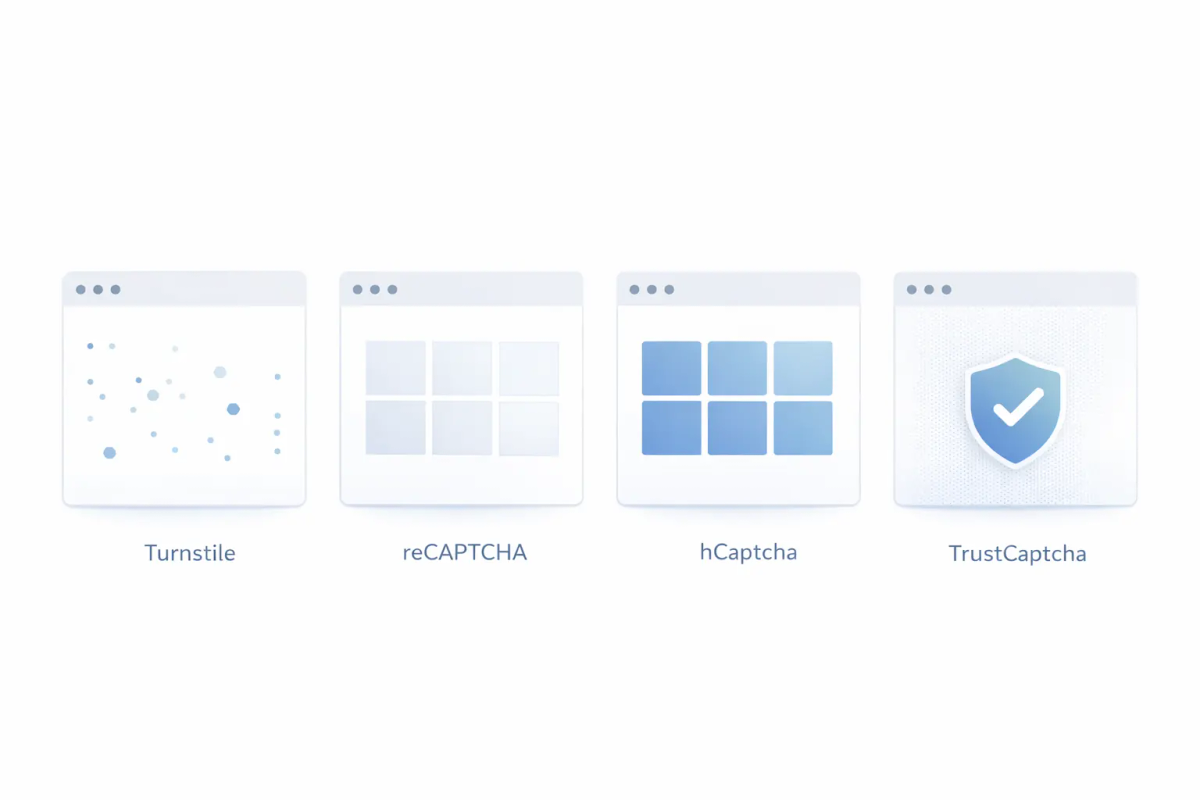
Cloudflare’s CAPTCHA is called Turnstile. It aims to verify visitors without presenting visual puzzles in normal cases. This experience depends heavily on how well Cloudflare can interpret the visitor’s browser and environment. When signals are clear and familiar, verification typically happens silently in the background and users proceed without noticing that any check took place. However, when confidence is lower—such as when users rely on privacy tools, strict corporate browser policies, accessibility software, or uncommon devices—the experience can change. In these cases, Turnstile may escalate verification and require additional interaction, such as displaying a checkbox or blocking the request entirely. From a user’s perspective, this can feel unpredictable: some sessions pass seamlessly, while others are stopped with little explanation.
Why enterprises consider Cloudflare CAPTCHA Alternatives
A common reason is false positives in privacy-heavy or locked-down environments. When users block JavaScript execution, limit telemetry, run hardened browsers, or use assistive tooling, the signal picture can degrade. If the solution leans too heavily on that signal picture, the outcome becomes less predictable.
Another reason is governance. Security and compliance stakeholders want clear answers: what is processed, what is stored (if anything), what is configurable per endpoint, and what evidence exists to justify decisions. When those answers aren’t easy to document, teams look at Cloudflare CAPTCHA Alternatives that provide simpler policy control and clearer privacy posture.
TrustCaptcha - European Turnstile Alternative
TrustCaptcha is built for enterprise buyers who want bot defense to be effective while staying out of the user’s way. The design goal is to reduce friction, minimize accessibility issues, and remain resilient as automated attacks evolve.
How TrustCaptcha protects applications
TrustCaptcha replaces visible challenges with background verification and mechanisms that are costly to run at bot scale. A central idea is a proof-of-work style computation: the client device performs a small computational task that is typically negligible for a legitimate user session but becomes expensive for automation that tries to run thousands of requests. This shifts the bottleneck away from “can the bot solve a puzzle?” and toward “can the attacker afford to operate at scale?” That’s a much more durable defensive posture against modern automation, including AI-assisted tooling.
TrustCaptcha also supports adaptive enforcement so different endpoints can be protected differently. That matters because enterprise applications usually have multiple risk tiers: a newsletter signup is not the same as a password reset, and the optimal security/usability balance differs across them.
TrustCaptcha strengths
- Invisible experience for legitimate users in normal cases
- Proof-of-work style resistance that raises the cost of large-scale automation
- Privacy-forward design goals that avoid tracking-style approaches
- Strong accessibility posture because verification does not depend on visual puzzles
- Enterprise-friendly control surfaces for tuning across endpoints and threat levels
TrustCaptcha limitation
- Free usage is typically limited to evaluation and testing, with paid plans for ongoing production requirements
Google reCAPTCHA
Google reCAPTCHA is widely known and broadly deployed, which is exactly why it often ends up on shortlists. However, for many enterprise buyers, the deeper evaluation typically leads to a consistent conclusion: reCAPTCHA can add privacy and consent overhead that is hard to justify unless brand familiarity is the dominant requirement.
Technically, reCAPTCHA relies heavily on behavioral and telemetry-based assessment, especially in its risk-scoring variants. That can be convenient when signals are available, but it can become problematic when privacy tooling or consent choices reduce the available data. In those conditions, user experience often degrades into interactive challenges, reducing UX and conversion. Multiple privacy-focused analyses note that reCAPTCHA is not inherently GDPR-compliant out of the box and may require explicit consent and additional safeguards depending on jurisdiction and implementation.
In short: reCAPTCHA moves cost from bots to your users and your compliance process. If CAPTCHA consent is needed, users that choose to reject consent cannot use the platform at all.
hCaptcha
hCaptcha is commonly associated with image-based labeling challenges. It can reduce basic automated abuse, but it does so by explicitly requiring user interaction—an approach that is increasingly treated as a last resort for high-value flows.
The key drawback is structural: image challenges introduce friction into conversion funnels and increase the likelihood of abandonment. Additionally, as AI-assisted automation improves, image puzzles become less future-proof. Attackers can solve them using models, outsourcing, or hybrid approaches, while legitimate users still pay the usability cost.
In short: hCaptcha can work, but it makes humans do work, reducing satisfaction and conversion.
Side-by-side comparison of Cloudflare CAPTCHA Alternatives
The table below keeps the comparison factual and focuses on operational characteristics rather than marketing claims.
| Capability | TrustCaptcha | Cloudflare Turnstile | Google reCAPTCHA | hCaptcha |
|---|---|---|---|---|
| UX | Invisible, no user interaction | Mostly invisible, can hard-block | Inconsistent, challenge fallbacks | Intrusive by design |
| Privacy overhead | Low, privacy-first | Moderate, opaque | High (consent & telemetry) | Medium |
| Accessibility | Very High | Medium | Medium | Low |
| AI bot resistance | High | High | Medium | Medium |
| Enterprise control | High | Medium | Medium | Low |
| Visual customization | High | Low | Very Low | Medium |
| Key drawback | Limited free trial | Edge-case lockouts | Privacy & compliance issues | UX & accessibility |
Conclusion: Which alternative is the best choice?
The choice depends on project volume and requirements. reCAPTCHA often becomes a compliance and consent project in regulated environments. hCaptcha often becomes a UX and accessibility compromise.
TrustCaptcha bridges those gaps and offers strong protection that doesn’t require human work. Proof-of-work style verification changes the economics of large-scale automation without real users noticing.
Try TrustCaptcha for free
👉 Try TrustCaptcha for free if you want to validate the impact on your own traffic, including bot reduction and user completion rates. You can run a short pilot in under 30mins.