
'%3e%3crect%20width='32'%20height='24'%20fill='white'/%3e%3cpath%20fill-rule='evenodd'%20clip-rule='evenodd'%20d='M0%200V24H32V0H0Z'%20fill='%232E42A5'/%3e%3cmask%20id='mask0_270_67386'%20style='mask-type:luminance'%20maskUnits='userSpaceOnUse'%20x='0'%20y='0'%20width='32'%20height='24'%3e%3cpath%20fill-rule='evenodd'%20clip-rule='evenodd'%20d='M0%200V24H32V0H0Z'%20fill='white'/%3e%3c/mask%3e%3cg%20mask='url(%23mask0_270_67386)'%3e%3cpath%20d='M-3.56323%2022.2854L3.47846%2025.2635L32.1597%203.23787L35.874%20-1.18761L28.344%20-2.18297L16.6456%207.3085L7.22956%2013.7035L-3.56323%2022.2854Z'%20fill='white'/%3e%3cpath%20d='M-2.59924%2024.3719L0.988173%2026.1001L34.5402%20-1.59881H29.5031L-2.59924%2024.3719Z'%20fill='%23F50100'/%3e%3cpath%20d='M35.5631%2022.2854L28.5214%2025.2635L-0.159817%203.23787L-3.87415%20-1.18761L3.65593%20-2.18297L15.3543%207.3085L24.7703%2013.7035L35.5631%2022.2854Z'%20fill='white'/%3e%3cpath%20d='M35.3229%2023.7829L31.7355%2025.5111L17.4487%2013.6518L13.2129%2012.3267L-4.23151%20-1.17246H0.805637L18.2403%2012.0063L22.8713%2013.5952L35.3229%2023.7829Z'%20fill='%23F50100'/%3e%3cmask%20id='path-7-inside-1_270_67386'%20fill='white'%3e%3cpath%20fill-rule='evenodd'%20clip-rule='evenodd'%20d='M19.7777%20-2H12.2222V8H-1.97253V16H12.2222V26H19.7777V16H34.0275V8H19.7777V-2Z'/%3e%3c/mask%3e%3cpath%20fill-rule='evenodd'%20clip-rule='evenodd'%20d='M19.7777%20-2H12.2222V8H-1.97253V16H12.2222V26H19.7777V16H34.0275V8H19.7777V-2Z'%20fill='%23F50100'/%3e%3cpath%20d='M12.2222%20-2V-4H10.2222V-2H12.2222ZM19.7777%20-2H21.7777V-4H19.7777V-2ZM12.2222%208V10H14.2222V8H12.2222ZM-1.97253%208V6H-3.97253V8H-1.97253ZM-1.97253%2016H-3.97253V18H-1.97253V16ZM12.2222%2016H14.2222V14H12.2222V16ZM12.2222%2026H10.2222V28H12.2222V26ZM19.7777%2026V28H21.7777V26H19.7777ZM19.7777%2016V14H17.7777V16H19.7777ZM34.0275%2016V18H36.0275V16H34.0275ZM34.0275%208H36.0275V6H34.0275V8ZM19.7777%208H17.7777V10H19.7777V8ZM12.2222%200H19.7777V-4H12.2222V0ZM14.2222%208V-2H10.2222V8H14.2222ZM-1.97253%2010H12.2222V6H-1.97253V10ZM0.0274658%2016V8H-3.97253V16H0.0274658ZM12.2222%2014H-1.97253V18H12.2222V14ZM14.2222%2026V16H10.2222V26H14.2222ZM19.7777%2024H12.2222V28H19.7777V24ZM17.7777%2016V26H21.7777V16H17.7777ZM34.0275%2014H19.7777V18H34.0275V14ZM32.0275%208V16H36.0275V8H32.0275ZM19.7777%2010H34.0275V6H19.7777V10ZM17.7777%20-2V8H21.7777V-2H17.7777Z'%20fill='white'%20mask='url(%23path-7-inside-1_270_67386)'/%3e%3c/g%3e%3c/g%3e%3cdefs%3e%3cclipPath%20id='clip0_270_67386'%3e%3crect%20width='32'%20height='24'%20fill='white'/%3e%3c/clipPath%3e%3c/defs%3e%3c/svg%3e)
'%3e%3crect%20width='32'%20height='24'%20fill='white'/%3e%3cpath%20fill-rule='evenodd'%20clip-rule='evenodd'%20d='M0%2016H32V24H0V16Z'%20fill='%23FFD018'/%3e%3cpath%20fill-rule='evenodd'%20clip-rule='evenodd'%20d='M0%208H32V16H0V8Z'%20fill='%23E31D1C'/%3e%3cpath%20fill-rule='evenodd'%20clip-rule='evenodd'%20d='M0%200H32V8H0V0Z'%20fill='%23272727'/%3e%3c/g%3e%3cdefs%3e%3cclipPath%20id='clip0_270_67353'%3e%3crect%20width='32'%20height='24'%20fill='white'/%3e%3c/clipPath%3e%3c/defs%3e%3c/svg%3e)
'%3e%3crect%20width='32'%20height='24'%20fill='white'/%3e%3cpath%20fill-rule='evenodd'%20clip-rule='evenodd'%20d='M22%200H32V24H22V0Z'%20fill='%23F50100'/%3e%3cpath%20fill-rule='evenodd'%20clip-rule='evenodd'%20d='M0%200H12V24H0V0Z'%20fill='%232E42A5'/%3e%3cpath%20fill-rule='evenodd'%20clip-rule='evenodd'%20d='M10%200H22V24H10V0Z'%20fill='%23F7FCFF'/%3e%3c/g%3e%3cdefs%3e%3cclipPath%20id='clip0_270_67361'%3e%3crect%20width='32'%20height='24'%20fill='white'/%3e%3c/clipPath%3e%3c/defs%3e%3c/svg%3e)
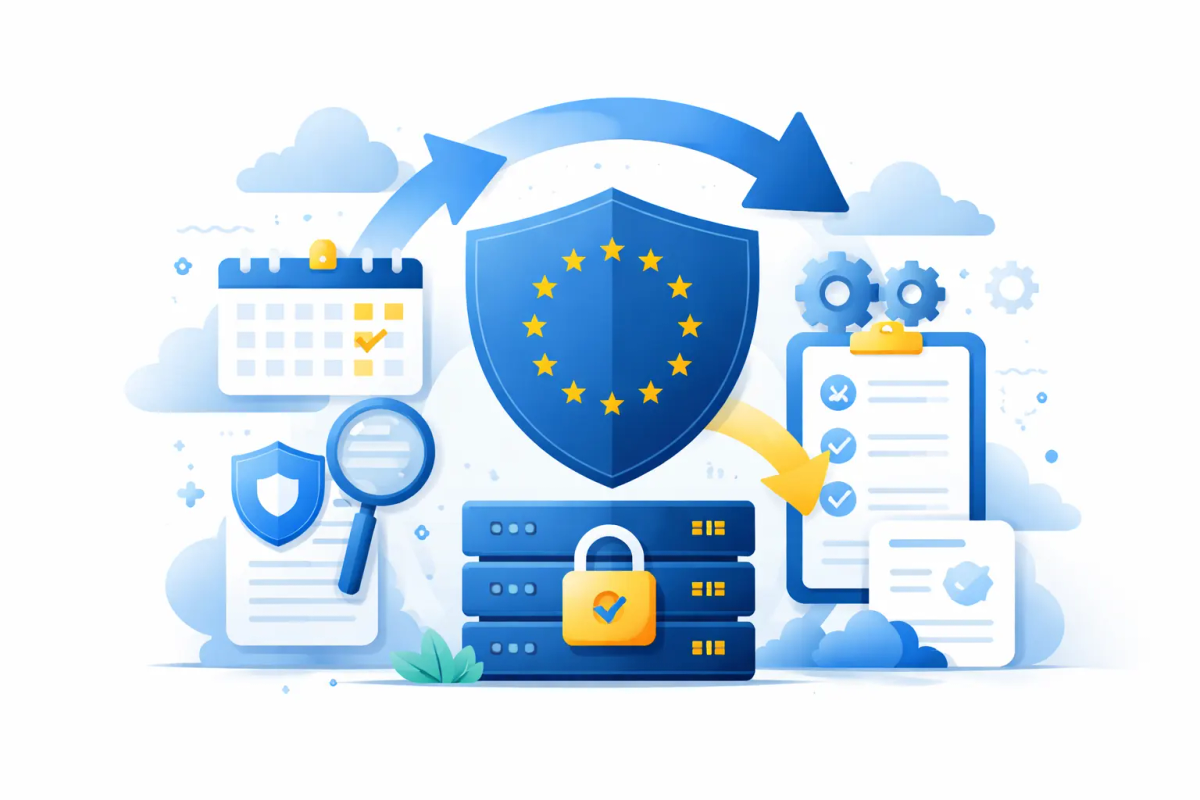
From April 2, 2026 onward, organizations using reCAPTCHA are no longer passive users of a third-party tool. They become the primary data controllers, meaning they are legally responsible for how user data is collected, processed, and justified under GDPR. This transition fundamentally changes the risk profile of reCAPTCHA usage.
Crucially, the technical behavior of reCAPTCHA remains the same. The system continues to operate as a largely opaque, data-intensive mechanism. The difference is that businesses now bear full accountability for it. This creates a tension between responsibility and control, which is particularly relevant for IT buyers operating in regulated environments.
What is reCAPTCHA and how does it work?
reCAPTCHA is one of the most widely recognized CAPTCHA systems on the web. For many organizations, it became the default choice simply because it was well known, easy to find, and widely adopted. Over time, reCAPTCHA evolved from simple human verification challenges into more complex forms of background assessment. Depending on the version, users may see a checkbox, an image puzzle, or no obvious challenge at all while the system evaluates signals behind the scenes.
At a basic level, reCAPTCHA is designed to determine whether a request is coming from a human or an automated actor. This is useful because attackers do not just target high-profile systems anymore. Even ordinary websites and business applications get hit by automated registration attempts, contact form abuse, spam submissions, inventory scraping, ticket abuse, brute-force login attempts, and data harvesting.
The idea behind reCAPTCHA is simple enough: use signals from the browser, the device, the network, or the interaction itself to estimate whether a visitor looks legitimate. The difficulty for many organizations is that this process is not especially transparent. Businesses are expected to rely on the decision, but they may not have complete clarity into the logic, the signals, the handling of the data, or the legal implications that come with it.
For years, many companies accepted that trade-off because reCAPTCHA was familiar and appeared to provide an acceptable level of protection. In 2026, however, that trade-off is coming under much closer scrutiny.
reCAPTCHA news 2026: what changed and why it is important
The Community Update of 2026 shifted the legal framing around who is responsible for the associated data processing. The key concern for organizations is that Google’s changed role does not automatically mean the service becomes more transparent, or easier to justify under privacy law. Instead, website operators may now bear more direct responsibility for that processing.
The organization responsible for the processing must be able to explain why the data is processed, what legal basis supports that use, how users are informed, how rights requests are handled, and how compliance obligations are documented. In practice, this makes reCAPTCHA a more sensitive procurement and governance decision than before.
In principle, that shift can be presented as a positive step because it clarifies responsibility. In practice, however, it does not give buyers more operational control over how reCAPTCHA actually works. The organization may be expected to justify and stand behind a tool whose internal operation remains partly opaque. That gap between increased responsibility and limited control is what makes the 2026 change important to evaluate.
Why GDPR and privacy concerns remain central
The transition to data controller status introduces a range of compliance obligations that extend beyond simple documentation updates. Organizations must now take a proactive role in managing the legal and operational aspects of reCAPTCHA usage.
One of the most immediate requirements is the need to define and document a lawful basis for processing. This involves assessing whether the use of reCAPTCHA can be justified under legitimate interest or whether explicit user consent is required. Each option carries its own implications for implementation and user experience.
Another critical aspect is transparency. GDPR requires organizations to clearly explain how personal data is collected and processed. With reCAPTCHA functioning as a “black box,” this can be difficult to achieve. Businesses must reconcile this lack of visibility with their obligation to provide meaningful disclosures.
International data transfers add another layer of complexity. If user data is processed outside the European Union, organizations must ensure that appropriate safeguards are in place. This remains a challenging area, particularly in light of evolving regulatory expectations.
Why CAPTCHA remains a necessary part of security architecture
None of this means that CAPTCHA itself is obsolete. In fact, CAPTCHA remains highly valuable. Automated abuse is not slowing down. Attackers continue to target exposed workflows that are easy to scale and cheap to exploit. Login pages, support forms, free trial signups, newsletter forms, password recovery flows, and payment-related endpoints are all regular targets.
Without some kind of human verification or bot mitigation layer, many public-facing systems become easy entry points for abuse. Bots can flood forms with junk, test stolen credentials, scrape content or pricing, overwhelm resources, and distort analytics. In more serious cases, these attacks contribute directly to fraud, account compromise, and service instability.
The lesson is not to abandon CAPTCHA, but to choose a CAPTCHA model that fits current realities. Modern organizations need a protection layer that does more than annoy users or slow attackers down for a few seconds. They need a solution that can genuinely improve security while still supporting privacy, accessibility, and business performance.
Why IT buyers should prioritize bot detection, not proof of work alone
Creating and deploying bots is now easier than ever. With the help of large language models, AI-assisted scripting, and widely available automation frameworks, attackers can generate more convincing and more scalable abuse traffic at lower cost. As a result, many organizations are seeing a sharp increase in spam submissions, fake registrations, credential-based attacks, and low-quality automated interactions that consume both system resources and team attention.
A proof-of-work-only CAPTCHA can still provide value in this environment. By adding computational cost to each request, it can discourage abuse and reduce some lower-value automated traffic. That is useful, especially against large-scale, low-effort attacks. However, proof of work on its own mainly changes the economics of abuse. It does not necessarily tell the organization which traffic is suspicious, how risky a request may be, or what type of response is most appropriate.
That is why an additional detection layer is so important. When proof of work is combined with bot detection, risk-based scoring, and configurable security rules, the CAPTCHA becomes much more than a passive speed bump. It becomes an active control point that helps organizations distinguish between low-risk and high-risk behavior and respond more intelligently. Instead of applying the same friction to everyone, teams can use stronger logic to reduce spam, block abusive patterns, and fine-tune protection according to the threat environment.
Even a partial reduction in abusive traffic can lead to a substantial drop in unwanted messages, fake submissions, and fraudulent interactions. This means more time spent on legitimate customer activity instead of bots.
Introducing TrustCaptcha: A Smarter Alternative
TrustCaptcha solves several problems at once. It helps organizations maintain a strong protection layer against automated abuse, but it does so without depending on the same privacy-heavy or friction-heavy model that has caused concern with older CAPTCHA systems. TrustCaptcha answers those concerns with a model that is better aligned with how bot protection needs to work today.
How TrustCaptcha protects with proof of work
The proof of work mechanism shifts part of the verification burden away from visible user interaction and toward a computational task that must be completed on the client side. For a legitimate user on a normal device, this workload is small and typically unobtrusive. For a large bot operation running at scale, however, that cost becomes meaningful.
That difference matters because many bot campaigns depend on economics. An attacker wants to perform large numbers of requests cheaply. If each request becomes more resource-intensive, the economics change. The attack becomes slower, more expensive, and harder to scale efficiently. This does not just “delay” a bot in the way a puzzle might. It directly increases the operational cost of abuse.
Another advantage is that proof of work does not depend on the same kind of overt user interruption that has made classic CAPTCHA experiences unpopular. Instead of forcing humans through repetitive challenges, it quietly changes the cost structure for automated traffic. That is a more elegant and more future-ready defense strategy.
How TrustCaptcha protects with bot scoring
Bot scoring is the second major pillar of TrustCaptcha’s approach. Rather than making a crude yes-or-no decision too early, bot scoring helps classify traffic with more nuance. The system evaluates signals and assigns a level of suspicion or confidence, which gives the organization more flexibility in how it responds.
This is important because not every suspicious request should be treated identically. Some may deserve blocking. Others may deserve throttling, secondary checks, or different policy responses. A bot score helps teams move from blunt enforcement to smarter decision-making.
Compared with traditional CAPTCHA tools that mostly ask the user to jump through hoops, bot scoring is a more sophisticated security capability. It helps separate low-risk and high-risk behavior more intelligently. That means less unnecessary friction for real users and more targeted intervention for suspicious traffic.
How TrustCaptcha combines these two mechanisms
Many legacy CAPTCHA tools rely on a basic assumption: if a user or bot has to do extra work, then abuse will drop. Sometimes that works against very simple automation. But it is not a complete modern strategy. A large attacker can often tolerate a little friction, outsource challenge solving, or engineer around a static barrier.
That matters because slowing a bot down is not the same thing as detecting a bot. A form challenge might delay an attacker briefly, but it does not necessarily help your team understand risk or respond intelligently. By contrast, proof of work plus bot scoring gives organizations both resistance and better signal quality.
TrustCaptcha as a privacy-friendly alternative
A privacy-friendly CAPTCHA solution is easier to justify internally and externally. It is easier to explain in documentation. It is easier to align with a careful data-minimization mindset. And it is less likely to create the same kind of governance discomfort that arises when teams depend on a tool that feels opaque or difficult to defend.
This becomes particularly important in the context of the reCAPTCHA processing changes. If buyers are already being asked to absorb more compliance burden, then they have a strong incentive to move toward a solution that reduces that burden rather than deepening it. TrustCaptcha fits that direction far better than legacy CAPTCHA models tied to older assumptions about tracking, verification, and user friction.
What organizations should do in response to reCAPTCHA news 2026
The practical next step is to evaluate whether the current CAPTCHA approach still aligns with business priorities. That means looking beyond simple familiarity or market presence. Buyers should ask whether the solution improves bot detection, fits privacy expectations, preserves user experience, and supports long-term governance.
For many businesses, that review will point towards a modern alternatives that addresses security, privacy, and usability together instead of treating them as competing goals.
If your team is reviewing reCAPTCHA with its new processor model and looking for a more future-ready solution, now is the right time to evaluate a better approach. 👉 Try TrustCaptcha for free and see how proof of work and bot scoring can improve your defense against modern bots without burdening legitimate users.