
'%3e%3crect%20width='32'%20height='24'%20fill='white'/%3e%3cpath%20fill-rule='evenodd'%20clip-rule='evenodd'%20d='M0%200V24H32V0H0Z'%20fill='%232E42A5'/%3e%3cmask%20id='mask0_270_67386'%20style='mask-type:luminance'%20maskUnits='userSpaceOnUse'%20x='0'%20y='0'%20width='32'%20height='24'%3e%3cpath%20fill-rule='evenodd'%20clip-rule='evenodd'%20d='M0%200V24H32V0H0Z'%20fill='white'/%3e%3c/mask%3e%3cg%20mask='url(%23mask0_270_67386)'%3e%3cpath%20d='M-3.56323%2022.2854L3.47846%2025.2635L32.1597%203.23787L35.874%20-1.18761L28.344%20-2.18297L16.6456%207.3085L7.22956%2013.7035L-3.56323%2022.2854Z'%20fill='white'/%3e%3cpath%20d='M-2.59924%2024.3719L0.988173%2026.1001L34.5402%20-1.59881H29.5031L-2.59924%2024.3719Z'%20fill='%23F50100'/%3e%3cpath%20d='M35.5631%2022.2854L28.5214%2025.2635L-0.159817%203.23787L-3.87415%20-1.18761L3.65593%20-2.18297L15.3543%207.3085L24.7703%2013.7035L35.5631%2022.2854Z'%20fill='white'/%3e%3cpath%20d='M35.3229%2023.7829L31.7355%2025.5111L17.4487%2013.6518L13.2129%2012.3267L-4.23151%20-1.17246H0.805637L18.2403%2012.0063L22.8713%2013.5952L35.3229%2023.7829Z'%20fill='%23F50100'/%3e%3cmask%20id='path-7-inside-1_270_67386'%20fill='white'%3e%3cpath%20fill-rule='evenodd'%20clip-rule='evenodd'%20d='M19.7777%20-2H12.2222V8H-1.97253V16H12.2222V26H19.7777V16H34.0275V8H19.7777V-2Z'/%3e%3c/mask%3e%3cpath%20fill-rule='evenodd'%20clip-rule='evenodd'%20d='M19.7777%20-2H12.2222V8H-1.97253V16H12.2222V26H19.7777V16H34.0275V8H19.7777V-2Z'%20fill='%23F50100'/%3e%3cpath%20d='M12.2222%20-2V-4H10.2222V-2H12.2222ZM19.7777%20-2H21.7777V-4H19.7777V-2ZM12.2222%208V10H14.2222V8H12.2222ZM-1.97253%208V6H-3.97253V8H-1.97253ZM-1.97253%2016H-3.97253V18H-1.97253V16ZM12.2222%2016H14.2222V14H12.2222V16ZM12.2222%2026H10.2222V28H12.2222V26ZM19.7777%2026V28H21.7777V26H19.7777ZM19.7777%2016V14H17.7777V16H19.7777ZM34.0275%2016V18H36.0275V16H34.0275ZM34.0275%208H36.0275V6H34.0275V8ZM19.7777%208H17.7777V10H19.7777V8ZM12.2222%200H19.7777V-4H12.2222V0ZM14.2222%208V-2H10.2222V8H14.2222ZM-1.97253%2010H12.2222V6H-1.97253V10ZM0.0274658%2016V8H-3.97253V16H0.0274658ZM12.2222%2014H-1.97253V18H12.2222V14ZM14.2222%2026V16H10.2222V26H14.2222ZM19.7777%2024H12.2222V28H19.7777V24ZM17.7777%2016V26H21.7777V16H17.7777ZM34.0275%2014H19.7777V18H34.0275V14ZM32.0275%208V16H36.0275V8H32.0275ZM19.7777%2010H34.0275V6H19.7777V10ZM17.7777%20-2V8H21.7777V-2H17.7777Z'%20fill='white'%20mask='url(%23path-7-inside-1_270_67386)'/%3e%3c/g%3e%3c/g%3e%3cdefs%3e%3cclipPath%20id='clip0_270_67386'%3e%3crect%20width='32'%20height='24'%20fill='white'/%3e%3c/clipPath%3e%3c/defs%3e%3c/svg%3e)
'%3e%3crect%20width='32'%20height='24'%20fill='white'/%3e%3cpath%20fill-rule='evenodd'%20clip-rule='evenodd'%20d='M0%2016H32V24H0V16Z'%20fill='%23FFD018'/%3e%3cpath%20fill-rule='evenodd'%20clip-rule='evenodd'%20d='M0%208H32V16H0V8Z'%20fill='%23E31D1C'/%3e%3cpath%20fill-rule='evenodd'%20clip-rule='evenodd'%20d='M0%200H32V8H0V0Z'%20fill='%23272727'/%3e%3c/g%3e%3cdefs%3e%3cclipPath%20id='clip0_270_67353'%3e%3crect%20width='32'%20height='24'%20fill='white'/%3e%3c/clipPath%3e%3c/defs%3e%3c/svg%3e)
'%3e%3crect%20width='32'%20height='24'%20fill='white'/%3e%3cpath%20fill-rule='evenodd'%20clip-rule='evenodd'%20d='M22%200H32V24H22V0Z'%20fill='%23F50100'/%3e%3cpath%20fill-rule='evenodd'%20clip-rule='evenodd'%20d='M0%200H12V24H0V0Z'%20fill='%232E42A5'/%3e%3cpath%20fill-rule='evenodd'%20clip-rule='evenodd'%20d='M10%200H22V24H10V0Z'%20fill='%23F7FCFF'/%3e%3c/g%3e%3cdefs%3e%3cclipPath%20id='clip0_270_67361'%3e%3crect%20width='32'%20height='24'%20fill='white'/%3e%3c/clipPath%3e%3c/defs%3e%3c/svg%3e)
Context: Why reCAPTCHA Still Matters for Enterprises
Despite growing criticism, Google’s reCAPTCHA remains widely deployed across enterprise applications, public-sector portals, SaaS platforms, and e-commerce flows. Its popularity stems from early market dominance, default inclusion in many frameworks, and perceived reliability through association with Google.
However, the threat landscape has evolved. Automated abuse is no longer limited to simple form spam. Credential stuffing, account takeover attempts, scraping, and AI-powered bots now mimic human behavior at scale. This evolution exposes structural weaknesses in both reCAPTCHA v2 and reCAPTCHA v3 that are especially relevant for professional buyers tasked with balancing security, compliance, and user experience.
This article explores those strengths and weaknesses, to help the evaluation and compare them directly.
reCAPTCHA v2
What reCAPTCHA v2 Is
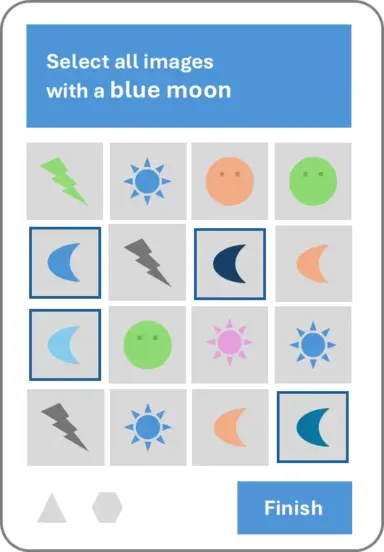
reCAPTCHA v2 is the second major iteration of Google’s CAPTCHA system and remains one of the most recognizable bot mitigation tools on the web. It introduced the familiar “I’m not a robot” checkbox and, when necessary, escalates verification through image recognition challenges.
While often perceived as simple and reliable, reCAPTCHA v2 was designed for a threat model that predates widespread AI-driven automation and behavioral spoofing. Its continued use today reflects familiarity rather than technical superiority.
How reCAPTCHA v2 Works
reCAPTCHA v2 begins with a checkbox interaction intended to verify human intent. Behind this interaction, Google evaluates contextual signals such as IP reputation, browser characteristics, and historical interaction patterns. If confidence is low, the user is required to complete a visual challenge, typically involving image classification tasks.
This mechanism creates a binary outcome. Either the user passes the challenge or does not. The system does not provide granular risk scoring or adaptive difficulty beyond escalating challenge complexity.
Core Features of reCAPTCHA v2
At its core, reCAPTCHA v2 combines visible verification with background risk signals. Its most prominent feature is the explicit human confirmation step, which acts as both a technical control and a psychological deterrent. The image challenges are generated dynamically and vary in difficulty depending on perceived risk.
Although reCAPTCHA v2 includes limited accessibility support, its reliance on visual interaction remains a structural constraint.
Security Characteristics of reCAPTCHA v2
From a security standpoint, reCAPTCHA v2 provides baseline protection against unsophisticated automation. However, modern bots can outsource challenge solving to CAPTCHA farms or leverage machine learning models capable of image recognition.
Because reCAPTCHA v2 relies heavily on static challenge-response validation, it struggles against distributed attacks and adversaries that separate challenge solving from request execution. As a result, its effectiveness diminishes significantly in high-risk environments.
Privacy and Compliance Considerations (v2)
reCAPTCHA v2 uses cookies and device-level signals to support risk analysis. While it generally relies on fewer persistent identifiers than reCAPTCHA v3, it still involves data transfers to Google infrastructure, often outside the jurisdiction of the end user.
For organizations subject to GDPR, CCPA, or similar regulations, this introduces consent and disclosure obligations. Regulatory scrutiny has increased in recent years, particularly regarding implicit data collection prior to user consent.
User Experience and Accessibility (v2)
User experience is one of the most criticized aspects of reCAPTCHA v2. Image challenges interrupt user flows, increase abandonment rates, and disproportionately affect users with visual or cognitive impairments.
As bots improve, challenges become more complex, further degrading usability for legitimate users. This creates a paradox where stronger security results in poorer experience without reliably stopping advanced threats.
Operational Strengths and Weaknesses of reCAPTCHA v2
Operationally, reCAPTCHA v2 is straightforward to deploy and requires minimal configuration. However, this simplicity comes at the cost of limited adaptability, poor analytics, and reduced effectiveness against modern attack patterns.
reCAPTCHA v3
What reCAPTCHA v3 Is
reCAPTCHA v3 represents a shift from challenge-based verification to continuous risk assessment. Instead of asking users to prove they are human, reCAPTCHA v3 evaluates behavior silently and assigns a score between 0.0 and 1.0 indicating the likelihood of automation.
This version is marketed as “invisible,” but invisibility introduces its own operational and ethical challenges.
How reCAPTCHA v3 Works
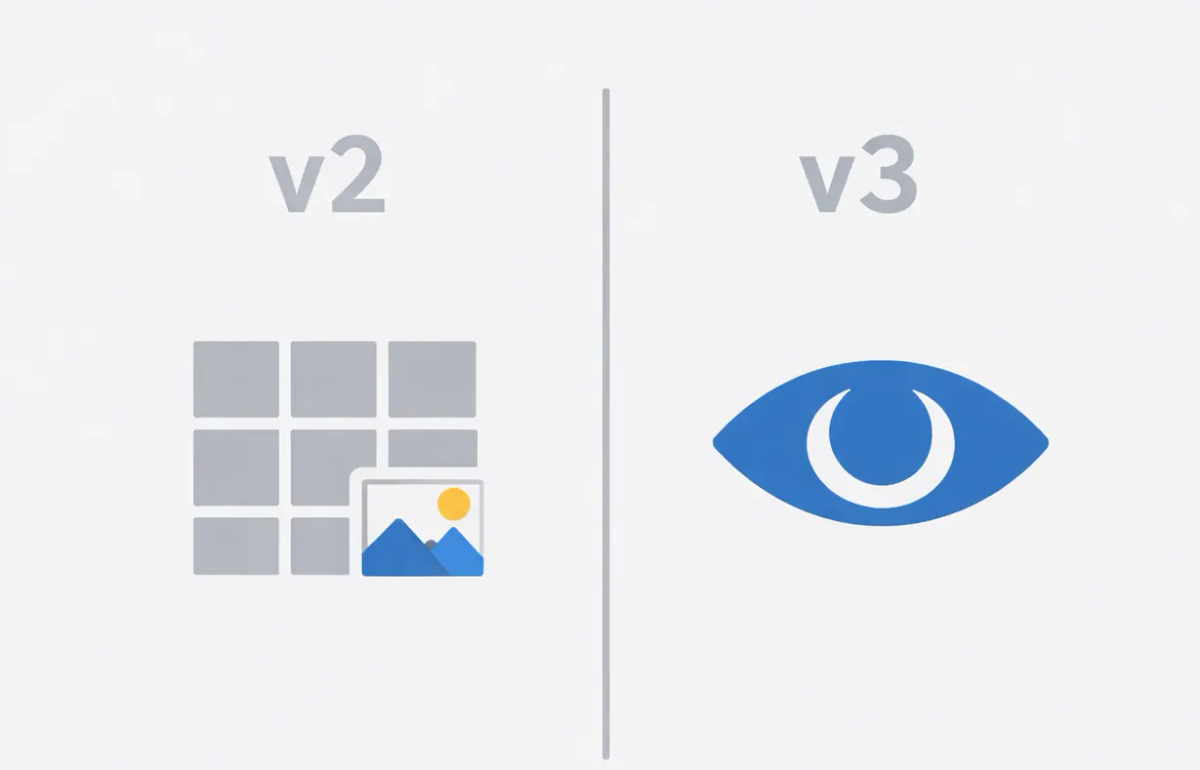
reCAPTCHA v3 monitors user interactions across pages where it is embedded. Mouse movements, timing patterns, navigation behavior, and browser attributes contribute to a behavioral profile. Each interaction generates a score, which site operators must interpret and act upon.
Unlike reCAPTCHA v2, reCAPTCHA v3 does not block users directly. Instead, it shifts enforcement decisions to the application layer, requiring developers to define thresholds and remediation flows.
Core Features of reCAPTCHA v3
The defining feature of reCAPTCHA v3 is adaptive risk scoring. This allows for differentiated handling of traffic rather than binary pass/fail decisions. It also enables passive monitoring without explicit user interruption under ideal conditions.
However, this flexibility increases implementation complexity and introduces ambiguity around decision-making.
Security Characteristics of reCAPTCHA v3
In theory, behavioral analysis provides stronger protection against automation than static challenges. In practice, modern bots increasingly simulate human interaction patterns, reducing the reliability of purely behavioral models.
reCAPTCHA v3 remains vulnerable to sophisticated adversaries that train bots to generate high scores, especially when scoring logic is opaque and feedback loops exist.
Privacy and Compliance Considerations (v3)
reCAPTCHA v3’s reliance on extensive behavioral tracking raises significant privacy concerns. It uses persistent cookies and cross-context data to build risk profiles, which can trigger consent requirements under multiple regulatory frameworks.
Because scoring logic and data usage are not fully transparent, organizations assume compliance risk without full visibility into data processing practices.
User Experience and Accessibility (v3)
For users who score well, reCAPTCHA v3 offers a smoother experience than v2. However, when scores fall into ambiguous ranges, fallback challenges are often introduced, negating the invisibility benefit.
Accessibility remains inconsistent, as fallback mechanisms frequently revert to visual challenges similar to reCAPTCHA v2.
Operational Strengths and Weaknesses of reCAPTCHA v3
Operationally, reCAPTCHA v3 requires continuous tuning. Thresholds must be adjusted, false positives investigated, and edge cases handled manually. This creates long-term maintenance overhead that is often underestimated during adoption.
Direct Comparison: reCAPTCHA v2 vs reCAPTCHA v3
When comparing reCAPTCHA v2 vs reCAPTCHA v3 directly, the differences reflect a trade-off between explicit friction and implicit surveillance. reCAPTCHA v2 is transparent but disruptive. reCAPTCHA v3 is discreet but opaque.
From a privacy perspective, reCAPTCHA v2 exposes users to fewer persistent behavioral identifiers, while reCAPTCHA v3 significantly expands data collection scope. From a security standpoint, reCAPTCHA v3 is more adaptive but still vulnerable to advanced automation. From a UX standpoint, reCAPTCHA v3 requires less interaction out of the box but depending on the implementation, neither solution consistently delivers frictionless protection at scale.
How to Choose Between reCAPTCHA v2 and reCAPTCHA v3
Choosing between reCAPTCHA v2 and reCAPTCHA v3 depends on risk tolerance rather than feature superiority. Organizations prioritizing minimal behavioral tracking may prefer v2 despite its usability drawbacks. Those seeking lower visible friction may lean toward v3 while accepting increased complexity and privacy exposure. In practice, some organizations deploy both, using v3 for scoring and v2 as a fallback. This hybrid approach compounds complexity without fully resolving underlying limitations.
Why Neither reCAPTCHA v2 nor v3 Is Optimal Today
Both reCAPTCHA v2 and reCAPTCHA v3 were designed around assumptions that no longer hold. The rise of AI-driven bots, increasing regulatory scrutiny, and heightened user sensitivity to privacy have exposed systemic weaknesses in both versions.
For organisations, this creates a gap between legacy CAPTCHA approaches and modern security requirements.
Introducing TrustCaptcha as a Modern CAPTCHA Solution
What TrustCaptcha Is
TrustCaptcha is a modern CAPTCHA solution designed specifically to address the shortcomings of traditional challenge-based and behavior-only systems. It focuses on strong bot resistance and privacy-first design.
How TrustCaptcha Works (Proof-of-Work + Bot Score)
TrustCaptcha combines browser-based proof-of-work with adaptive bot scoring. Instead of asking users to solve puzzles or silently profiling them across sites, TrustCaptcha requires the device to perform computational work invisibly that real users don’t notice but make attacs inefficient for bots.
This mechanism naturally throttles automation without degrading user experience. The bot score dynamically adjusts difficulty and risk assessment, based on observed risk signals, allowing further control.
TrustCaptcha vs reCAPTCHA v2 vs reCAPTCHA v3
| Feature | reCAPTCHA v2 | reCAPTCHA v3 | TrustCaptcha |
|---|---|---|---|
| Bot Resistance | Moderate | Moderate–High | High |
| User Interaction | Frequent | Conditional | None |
| Behavioral Tracking | Limited | Extensive | Minimal |
| Proof-of-Work | No | No | Yes |
| Cookie Usage | Yes | Yes | No |
| Cross-Site Tracking | Possible | Likely | No |
| Accessibility | Limited | Partial | High |
| Compliance Risk | Medium | High | Low |
Conclusion
The comparison of reCAPTCHA v2 vs reCAPTCHA v3 highlights a fundamental limitation of legacy CAPTCHA models. v2 is outdated and reduces usability, while the other prioritizes invisibility at the cost of privacy and transparency. Neither fully meets the needs of modern, compliance-driven organizations.
TrustCaptcha represents a new generation of CAPTCHA technology, combining proof-of-work, adaptive bot scoring, and privacy-first design. For organizations seeking effective bot protection without compromising user trust, it offers a compelling alternative.
Call to Action
Experience modern bot protection without trade-offs. 👉 Try TrustCaptcha for free and see how modern CAPTCHA protection strengthens your bot protection strategy.