

'%3e%3crect%20width='32'%20height='24'%20fill='white'/%3e%3cpath%20fill-rule='evenodd'%20clip-rule='evenodd'%20d='M0%200V24H32V0H0Z'%20fill='%232E42A5'/%3e%3cmask%20id='mask0_270_67386'%20style='mask-type:luminance'%20maskUnits='userSpaceOnUse'%20x='0'%20y='0'%20width='32'%20height='24'%3e%3cpath%20fill-rule='evenodd'%20clip-rule='evenodd'%20d='M0%200V24H32V0H0Z'%20fill='white'/%3e%3c/mask%3e%3cg%20mask='url(%23mask0_270_67386)'%3e%3cpath%20d='M-3.56323%2022.2854L3.47846%2025.2635L32.1597%203.23787L35.874%20-1.18761L28.344%20-2.18297L16.6456%207.3085L7.22956%2013.7035L-3.56323%2022.2854Z'%20fill='white'/%3e%3cpath%20d='M-2.59924%2024.3719L0.988173%2026.1001L34.5402%20-1.59881H29.5031L-2.59924%2024.3719Z'%20fill='%23F50100'/%3e%3cpath%20d='M35.5631%2022.2854L28.5214%2025.2635L-0.159817%203.23787L-3.87415%20-1.18761L3.65593%20-2.18297L15.3543%207.3085L24.7703%2013.7035L35.5631%2022.2854Z'%20fill='white'/%3e%3cpath%20d='M35.3229%2023.7829L31.7355%2025.5111L17.4487%2013.6518L13.2129%2012.3267L-4.23151%20-1.17246H0.805637L18.2403%2012.0063L22.8713%2013.5952L35.3229%2023.7829Z'%20fill='%23F50100'/%3e%3cmask%20id='path-7-inside-1_270_67386'%20fill='white'%3e%3cpath%20fill-rule='evenodd'%20clip-rule='evenodd'%20d='M19.7777%20-2H12.2222V8H-1.97253V16H12.2222V26H19.7777V16H34.0275V8H19.7777V-2Z'/%3e%3c/mask%3e%3cpath%20fill-rule='evenodd'%20clip-rule='evenodd'%20d='M19.7777%20-2H12.2222V8H-1.97253V16H12.2222V26H19.7777V16H34.0275V8H19.7777V-2Z'%20fill='%23F50100'/%3e%3cpath%20d='M12.2222%20-2V-4H10.2222V-2H12.2222ZM19.7777%20-2H21.7777V-4H19.7777V-2ZM12.2222%208V10H14.2222V8H12.2222ZM-1.97253%208V6H-3.97253V8H-1.97253ZM-1.97253%2016H-3.97253V18H-1.97253V16ZM12.2222%2016H14.2222V14H12.2222V16ZM12.2222%2026H10.2222V28H12.2222V26ZM19.7777%2026V28H21.7777V26H19.7777ZM19.7777%2016V14H17.7777V16H19.7777ZM34.0275%2016V18H36.0275V16H34.0275ZM34.0275%208H36.0275V6H34.0275V8ZM19.7777%208H17.7777V10H19.7777V8ZM12.2222%200H19.7777V-4H12.2222V0ZM14.2222%208V-2H10.2222V8H14.2222ZM-1.97253%2010H12.2222V6H-1.97253V10ZM0.0274658%2016V8H-3.97253V16H0.0274658ZM12.2222%2014H-1.97253V18H12.2222V14ZM14.2222%2026V16H10.2222V26H14.2222ZM19.7777%2024H12.2222V28H19.7777V24ZM17.7777%2016V26H21.7777V16H17.7777ZM34.0275%2014H19.7777V18H34.0275V14ZM32.0275%208V16H36.0275V8H32.0275ZM19.7777%2010H34.0275V6H19.7777V10ZM17.7777%20-2V8H21.7777V-2H17.7777Z'%20fill='white'%20mask='url(%23path-7-inside-1_270_67386)'/%3e%3c/g%3e%3c/g%3e%3cdefs%3e%3cclipPath%20id='clip0_270_67386'%3e%3crect%20width='32'%20height='24'%20fill='white'/%3e%3c/clipPath%3e%3c/defs%3e%3c/svg%3e)
'%3e%3crect%20width='32'%20height='24'%20fill='white'/%3e%3cpath%20fill-rule='evenodd'%20clip-rule='evenodd'%20d='M0%2016H32V24H0V16Z'%20fill='%23FFD018'/%3e%3cpath%20fill-rule='evenodd'%20clip-rule='evenodd'%20d='M0%208H32V16H0V8Z'%20fill='%23E31D1C'/%3e%3cpath%20fill-rule='evenodd'%20clip-rule='evenodd'%20d='M0%200H32V8H0V0Z'%20fill='%23272727'/%3e%3c/g%3e%3cdefs%3e%3cclipPath%20id='clip0_270_67353'%3e%3crect%20width='32'%20height='24'%20fill='white'/%3e%3c/clipPath%3e%3c/defs%3e%3c/svg%3e)
'%3e%3crect%20width='32'%20height='24'%20fill='white'/%3e%3cpath%20fill-rule='evenodd'%20clip-rule='evenodd'%20d='M22%200H32V24H22V0Z'%20fill='%23F50100'/%3e%3cpath%20fill-rule='evenodd'%20clip-rule='evenodd'%20d='M0%200H12V24H0V0Z'%20fill='%232E42A5'/%3e%3cpath%20fill-rule='evenodd'%20clip-rule='evenodd'%20d='M10%200H22V24H10V0Z'%20fill='%23F7FCFF'/%3e%3c/g%3e%3cdefs%3e%3cclipPath%20id='clip0_270_67361'%3e%3crect%20width='32'%20height='24'%20fill='white'/%3e%3c/clipPath%3e%3c/defs%3e%3c/svg%3e)
TrustCaptcha and NIS2
TrustCaptcha protects digital services from automated abuse with a no-interaction invisible CAPTCHA. There are no puzzles, no clicks and no user friction: the widget starts on its own. That matters for NIS2-aligned security programs because bot attacks often target the exact workflows that must stay reliable: login, password reset, signup and high-value forms.
The NIS2 Directive in brief
NIS2 (the EU’s updated Network and Information Security directive) raises expectations for cyber risk management and operational resilience for many organizations, including essential and important entities (depending on sector and size). In practice, it pushes organizations to adopt consistent security controls, governance and incident handling. Whether your organization is in scope is a legal question; this page is not legal advice, so check it with your legal adviser or compliance team.
NIS2-aligned programs typically focus on:
- reducing likelihood of incidents (prevention),
- limiting impact when incidents occur (resilience),
- improving detection and response (monitoring and incident handling),
- and proving you manage third-party/supply-chain risk responsibly.
For official background text, see the EU’s publication on EUR-Lex: NIS2 Directive (EU) 2022/2555 (EUR-Lex)
What TrustCaptcha does
TrustCaptcha distinguishes humans from automated abuse. On every plan, the visitor’s browser solves a proof-of-work task that gets harder with the risk of the request; from the Solo plan, each interaction also gets a bot score from 0 (very likely human) to 1 (very likely bot). It helps defend against patterns such as:
- credential stuffing and brute-force attempts,
- scripted form submissions and spam,
- scraping and automated enumeration,
- high-volume automated traffic intended to degrade service.
Because TrustCaptcha is invisible, legitimate users are not pushed into time-consuming challenges. That should help conversion and keep support tickets down, while automated attacks get stopped.
How TrustCaptcha supports NIS2-aligned security measures
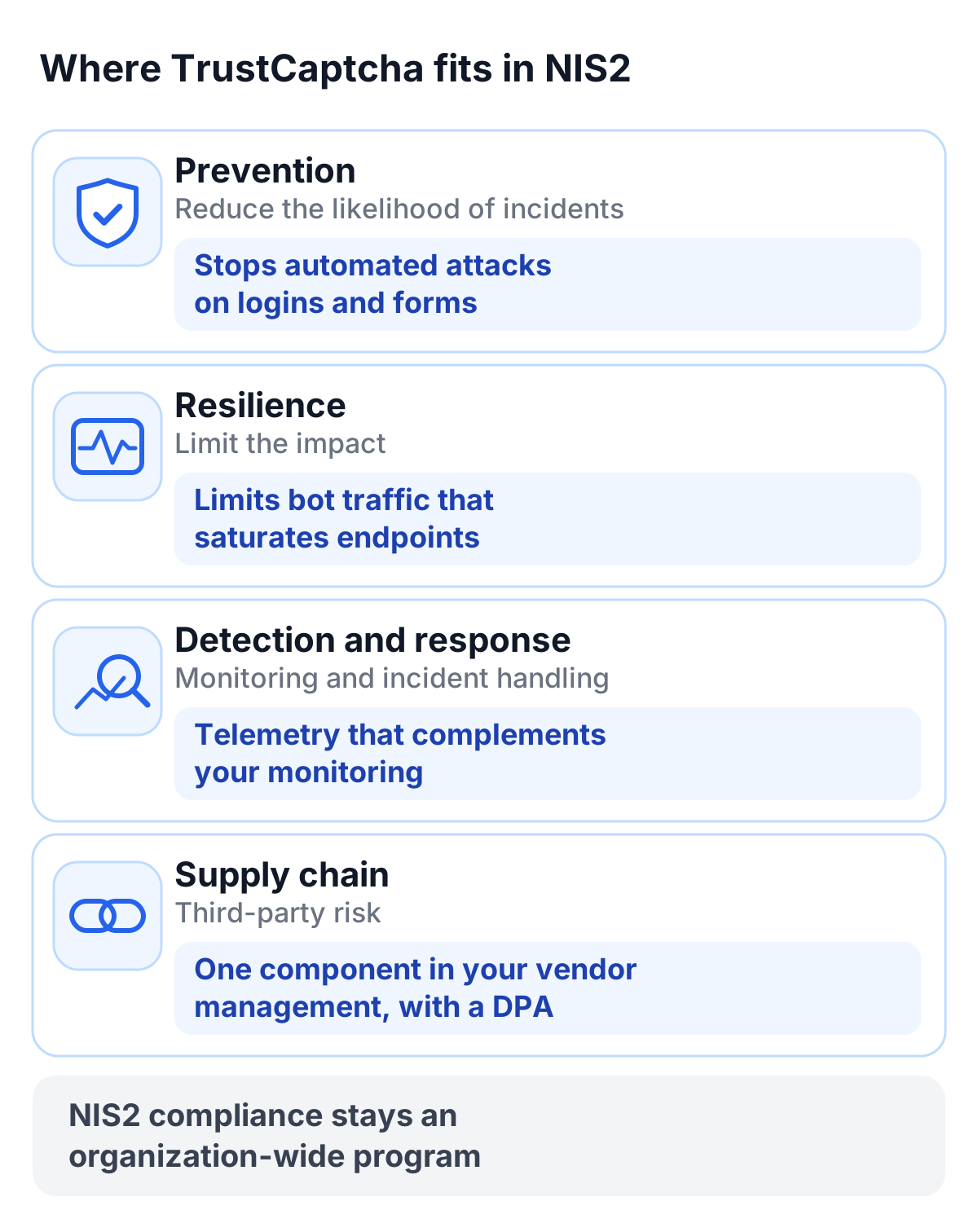
NIS2 asks for “appropriate and proportionate” technical, operational and organizational measures. TrustCaptcha fits most naturally into prevention, resilience and monitoring support.
1) Risk management and attack surface reduction
Bot abuse is a recurring driver of incidents: account takeover, fraud, service degradation, and noisy alerts that slow down response. TrustCaptcha reduces this risk by placing a control at high-risk entry points (authentication and forms).
In risk terms, TrustCaptcha helps you:
- reduce likelihood of successful automated attacks,
- lower load and churn during attack spikes,
- and concentrate response effort on higher-signal events.
2) Availability and resilience for critical user journeys
NIS2 emphasizes resilience of network and information systems. TrustCaptcha supports resilience by limiting automated traffic that can saturate endpoints, overwhelm queues, or trigger cascading failures.
Practical impact:
- fewer abusive requests reaching application logic,
- fewer downstream failures (rate-limits, database hotspots),
- improved stability for legitimate users during attack periods.
3) Detection signals and operational monitoring support
Effective incident response depends on visibility. TrustCaptcha can provide security-relevant telemetry that complements your monitoring stack, helping teams answer:
- “Which endpoint is being targeted?”
- “Is the traffic likely automated?”
- “When did the pattern start, and how is it evolving?”
TrustCaptcha does not replace SIEM or SOC workflows, but it can increase confidence and reduce false positives when correlated with your logs.
4) Secure-by-design posture for bot protection
TrustCaptcha defends against bots without tracking-heavy approaches. Processing is focused on making a security decision: whether an interaction is likely human or automated abuse.
That helps governance teams explain:
- why the control is necessary (security and integrity),
- what it does (risk assessment),
- and why it is proportionate (minimized, purpose-limited processing).
5) Access control and operational security
NIS2-aligned measures commonly include strong access control and secure operations. TrustCaptcha supports this posture with operational controls such as:
- controlled access to operational data,
- separation of environments and disciplined change handling,
- secure handling of configuration and keys/tokens used for verification.
The exact control set depends on your deployment, but the goal is consistent: limit who can change security behavior and who can access security telemetry.
6) Data handling and retention discipline for security telemetry
Security telemetry is useful, but it should not persist “just in case.” TrustCaptcha is designed with retention discipline in mind so data does not remain without purpose.
For NIS2 governance and audits, that gives you a simple account:
- the data is collected for security,
- it is retained only as long as operationally necessary,
- and it is subject to cleanup controls.
7) Supply-chain and vendor assurance alignment
NIS2 increases attention on supply-chain security. TrustCaptcha supports vendor assurance by providing the kind of information that procurement and security teams commonly need:
- a clear description of the service and its purpose,
- documentation of security measures,
- a transparent description of data handling for internal risk assessment.
Your vendor management process (due diligence, contracts, periodic review) stays in place. TrustCaptcha fits into it as one controllable component.
Implementation guidance for NIS2 programs
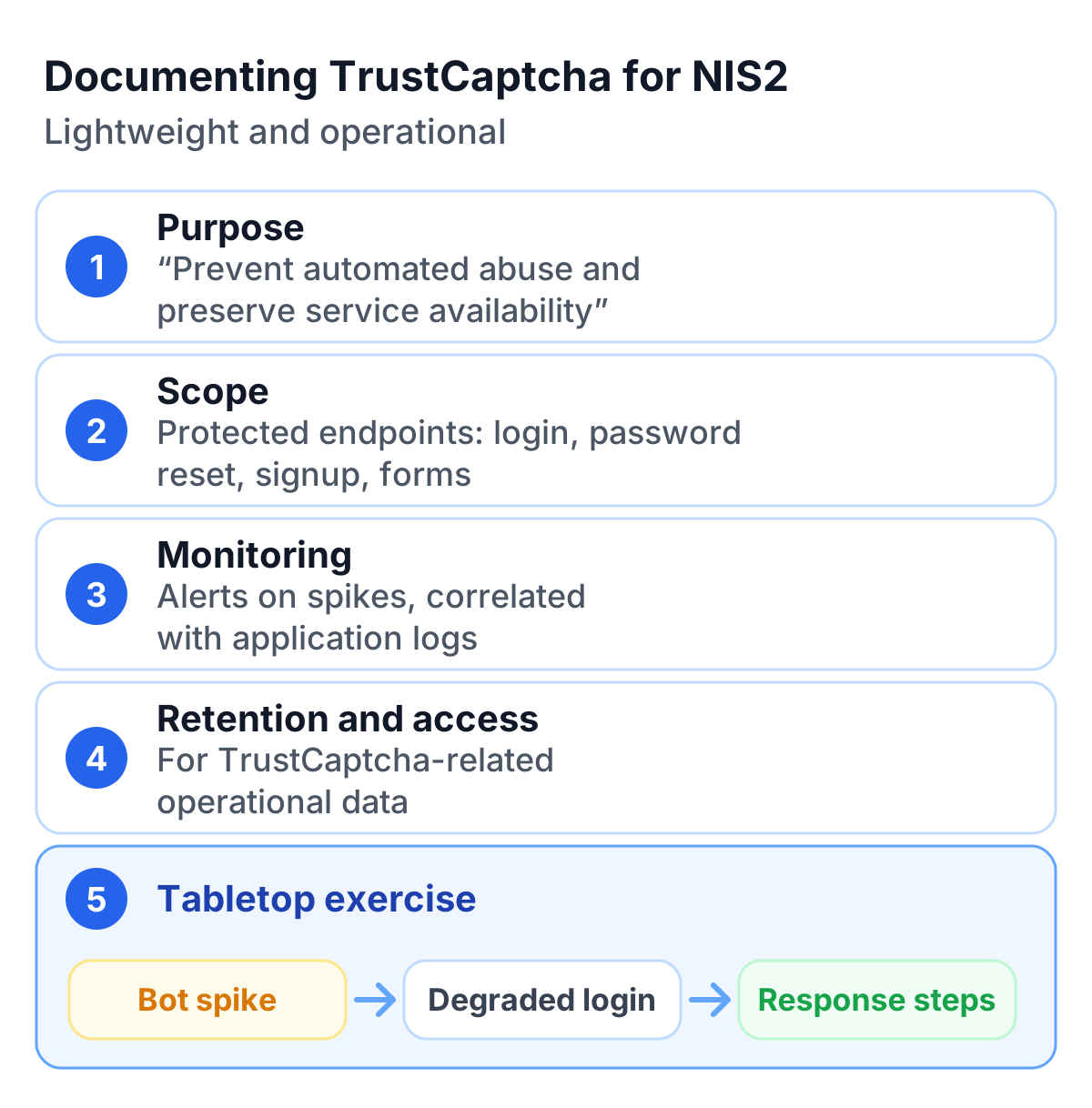
Keep documentation lightweight and operational:
- Define the security purpose in plain language: “prevent automated abuse and preserve service availability.”
- Connect TrustCaptcha to monitoring: alert on anomalous spikes and correlate with application logs.
- Document retention and access control for TrustCaptcha-related operational data.
- Include TrustCaptcha in tabletop exercises: “bot spike → degraded login → response steps.”
Why TrustCaptcha is a practical NIS2-ready control
NIS2 is about using security controls that reduce risk in places attackers target most. Automated abuse is a high-frequency threat because it’s cheap to run and scales fast. When attackers can flood login and form endpoints, the result is account takeover attempts, fraud, operational disruption and noise for incident response.
TrustCaptcha reduces that risk without creating user friction. Legitimate users get through without a challenge, while the risk-based decision blocks or flags abusive automation early. For NIS2-aligned programs, where resilience and continuity count as much as detection, that means fewer noisy security events, fewer emergency rate limits and more stable service for real users.
TrustCaptcha is also easy to explain internally: a focused security measure with a clear purpose, a limited scope (only critical endpoints) and documentation governance teams can use. That makes it straightforward to include in risk registers, control mappings and audit records.
Next steps
If you’re building or strengthening your NIS2 program, a simple next move is to protect the endpoints that are most likely to be attacked and most costly to lose.
Suggested rollout:
- Start with login, password reset, and signup
- Add high-value forms (contact, quote, checkout, newsletter)
- Tune thresholds and actions based on observed traffic
- Connect events to your monitoring/alerting to support incident response
Every plan comes with a 14-day free trial. Try TrustCaptcha for free on your critical flows and document it as a NIS2-aligned control for prevention and resilience.