

'%3e%3crect%20width='32'%20height='24'%20fill='white'/%3e%3cpath%20fill-rule='evenodd'%20clip-rule='evenodd'%20d='M0%200V24H32V0H0Z'%20fill='%232E42A5'/%3e%3cmask%20id='mask0_270_67386'%20style='mask-type:luminance'%20maskUnits='userSpaceOnUse'%20x='0'%20y='0'%20width='32'%20height='24'%3e%3cpath%20fill-rule='evenodd'%20clip-rule='evenodd'%20d='M0%200V24H32V0H0Z'%20fill='white'/%3e%3c/mask%3e%3cg%20mask='url(%23mask0_270_67386)'%3e%3cpath%20d='M-3.56323%2022.2854L3.47846%2025.2635L32.1597%203.23787L35.874%20-1.18761L28.344%20-2.18297L16.6456%207.3085L7.22956%2013.7035L-3.56323%2022.2854Z'%20fill='white'/%3e%3cpath%20d='M-2.59924%2024.3719L0.988173%2026.1001L34.5402%20-1.59881H29.5031L-2.59924%2024.3719Z'%20fill='%23F50100'/%3e%3cpath%20d='M35.5631%2022.2854L28.5214%2025.2635L-0.159817%203.23787L-3.87415%20-1.18761L3.65593%20-2.18297L15.3543%207.3085L24.7703%2013.7035L35.5631%2022.2854Z'%20fill='white'/%3e%3cpath%20d='M35.3229%2023.7829L31.7355%2025.5111L17.4487%2013.6518L13.2129%2012.3267L-4.23151%20-1.17246H0.805637L18.2403%2012.0063L22.8713%2013.5952L35.3229%2023.7829Z'%20fill='%23F50100'/%3e%3cmask%20id='path-7-inside-1_270_67386'%20fill='white'%3e%3cpath%20fill-rule='evenodd'%20clip-rule='evenodd'%20d='M19.7777%20-2H12.2222V8H-1.97253V16H12.2222V26H19.7777V16H34.0275V8H19.7777V-2Z'/%3e%3c/mask%3e%3cpath%20fill-rule='evenodd'%20clip-rule='evenodd'%20d='M19.7777%20-2H12.2222V8H-1.97253V16H12.2222V26H19.7777V16H34.0275V8H19.7777V-2Z'%20fill='%23F50100'/%3e%3cpath%20d='M12.2222%20-2V-4H10.2222V-2H12.2222ZM19.7777%20-2H21.7777V-4H19.7777V-2ZM12.2222%208V10H14.2222V8H12.2222ZM-1.97253%208V6H-3.97253V8H-1.97253ZM-1.97253%2016H-3.97253V18H-1.97253V16ZM12.2222%2016H14.2222V14H12.2222V16ZM12.2222%2026H10.2222V28H12.2222V26ZM19.7777%2026V28H21.7777V26H19.7777ZM19.7777%2016V14H17.7777V16H19.7777ZM34.0275%2016V18H36.0275V16H34.0275ZM34.0275%208H36.0275V6H34.0275V8ZM19.7777%208H17.7777V10H19.7777V8ZM12.2222%200H19.7777V-4H12.2222V0ZM14.2222%208V-2H10.2222V8H14.2222ZM-1.97253%2010H12.2222V6H-1.97253V10ZM0.0274658%2016V8H-3.97253V16H0.0274658ZM12.2222%2014H-1.97253V18H12.2222V14ZM14.2222%2026V16H10.2222V26H14.2222ZM19.7777%2024H12.2222V28H19.7777V24ZM17.7777%2016V26H21.7777V16H17.7777ZM34.0275%2014H19.7777V18H34.0275V14ZM32.0275%208V16H36.0275V8H32.0275ZM19.7777%2010H34.0275V6H19.7777V10ZM17.7777%20-2V8H21.7777V-2H17.7777Z'%20fill='white'%20mask='url(%23path-7-inside-1_270_67386)'/%3e%3c/g%3e%3c/g%3e%3cdefs%3e%3cclipPath%20id='clip0_270_67386'%3e%3crect%20width='32'%20height='24'%20fill='white'/%3e%3c/clipPath%3e%3c/defs%3e%3c/svg%3e)
'%3e%3crect%20width='32'%20height='24'%20fill='white'/%3e%3cpath%20fill-rule='evenodd'%20clip-rule='evenodd'%20d='M0%2016H32V24H0V16Z'%20fill='%23FFD018'/%3e%3cpath%20fill-rule='evenodd'%20clip-rule='evenodd'%20d='M0%208H32V16H0V8Z'%20fill='%23E31D1C'/%3e%3cpath%20fill-rule='evenodd'%20clip-rule='evenodd'%20d='M0%200H32V8H0V0Z'%20fill='%23272727'/%3e%3c/g%3e%3cdefs%3e%3cclipPath%20id='clip0_270_67353'%3e%3crect%20width='32'%20height='24'%20fill='white'/%3e%3c/clipPath%3e%3c/defs%3e%3c/svg%3e)
'%3e%3crect%20width='32'%20height='24'%20fill='white'/%3e%3cpath%20fill-rule='evenodd'%20clip-rule='evenodd'%20d='M22%200H32V24H22V0Z'%20fill='%23F50100'/%3e%3cpath%20fill-rule='evenodd'%20clip-rule='evenodd'%20d='M0%200H12V24H0V0Z'%20fill='%232E42A5'/%3e%3cpath%20fill-rule='evenodd'%20clip-rule='evenodd'%20d='M10%200H22V24H10V0Z'%20fill='%23F7FCFF'/%3e%3c/g%3e%3cdefs%3e%3cclipPath%20id='clip0_270_67361'%3e%3crect%20width='32'%20height='24'%20fill='white'/%3e%3c/clipPath%3e%3c/defs%3e%3c/svg%3e)
Privacy-compliant CAPTCHA
How TrustCaptcha handles personal data, and which privacy laws matter for a CAPTCHA.
Privacy as a core design principle
TrustCaptcha was built on privacy by design: it uses data for verification only, sets no cookies and builds no profiles.
TrustCaptcha was built on one principle: security should not cost your visitors their privacy. A privacy-compliant CAPTCHA has to stop bots without watching people. Older CAPTCHA approaches rely on behavioral monitoring or cross-site signals, while TrustCaptcha uses the data it receives for verification only. It sets no cookies, keeps data to a minimum and creates no persistent identifiers, and processing takes place in EU data centers. That makes it a good fit for companies that work under strict privacy rules in several regions.
Designed for privacy-first deployments
TrustCaptcha operates as a security control, not a data collection layer.
- ✓ No cookies set on user devices
- ✓ Security-only purpose limitation
- ✓ Clear documentation for reviews
CAPTCHA privacy laws around the world
GDPR
Under the GDPR, CAPTCHA-related data (e.g., IP address, device/browser signals, and interaction patterns) can be personal data. If your company is established in the EU or if you serve users there, you typically need a legal basis for the processing and a clear explanation in your privacy notice.
What TrustCaptcha does about it is summed up on our product page for the GDPR-compliant CAPTCHA.
Data sovereignty
Data sovereignty is about who controls verification data and where it is processed. TrustCaptcha processes it in EU data centers.
CCPA / CPRA (California)
TrustCaptcha does not sell or share personal data and builds no profiles, which are the practices California's privacy law looks at most closely.
LGPD (Brazil)
TrustCaptcha collects only what verification needs, uses no persistent identifiers and does not reuse the data for other purposes.
CPPA (Canada)
Minimal processing and clear documentation help meet the law's expectation that processing is proportional and limited to its purpose.
DPDPA (India)
Verification used only for security, with as little data as possible, fits the data minimization principles of India's DPDP Act.
PDPA (Singapore)
TrustCaptcha does no profiling and no persistent tracking, so the data stays within its security purpose.
PIPL (China)
Because TrustCaptcha does no tracking, it fits the data minimization and purpose limitation principles in the PIPL.
APPI (Japan)
Processing is limited to one stated purpose, security, which matches the APPI's focus on a clearly specified purpose of use.
Australian Privacy Act
TrustCaptcha collects no more than verification needs, in line with the Act's principles on collecting and handling personal information.
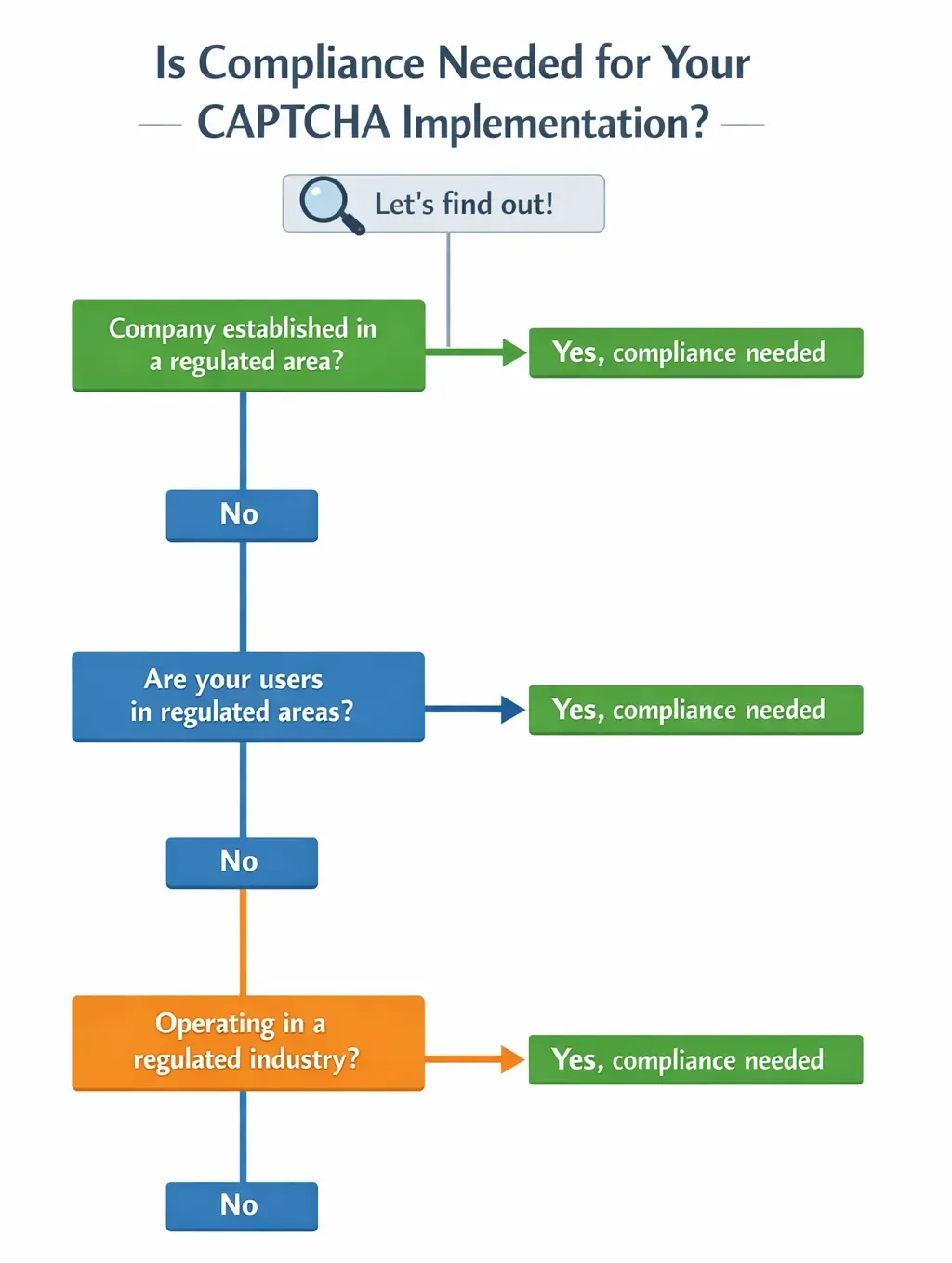
Which CAPTCHA laws apply to me?
It depends on where you operate and who you serve
International organizations often fall under multiple privacy regimes at once, especially when serving users across borders.
The privacy laws that apply to your CAPTCHA implementation depend on where your company is established, where your end users are located, and the regulatory expectations of your industry.
TrustCaptcha keeps data use small, does no tracking and keeps the CAPTCHA focused on security instead of user analysis. That makes overlapping obligations easier to meet.
Data protection resources
Documentation that simplifies reviews
For legal, security, product and procurement teams.
Data Processing Agreement (DPA)
Every customer gets a DPA that sets out TrustCaptcha's role as your processor.
Request DPANeed help with a vendor/security questionnaire?
Contact us and we'll help you answer the questions about TrustCaptcha.
Contact UsFrequently Asked Questions
Questions about CAPTCHA privacy
Short answers to what legal and security teams ask most often. For anything else, contact us.