
'%3e%3crect%20width='32'%20height='24'%20fill='white'/%3e%3cpath%20fill-rule='evenodd'%20clip-rule='evenodd'%20d='M0%200V24H32V0H0Z'%20fill='%232E42A5'/%3e%3cmask%20id='mask0_270_67386'%20style='mask-type:luminance'%20maskUnits='userSpaceOnUse'%20x='0'%20y='0'%20width='32'%20height='24'%3e%3cpath%20fill-rule='evenodd'%20clip-rule='evenodd'%20d='M0%200V24H32V0H0Z'%20fill='white'/%3e%3c/mask%3e%3cg%20mask='url(%23mask0_270_67386)'%3e%3cpath%20d='M-3.56323%2022.2854L3.47846%2025.2635L32.1597%203.23787L35.874%20-1.18761L28.344%20-2.18297L16.6456%207.3085L7.22956%2013.7035L-3.56323%2022.2854Z'%20fill='white'/%3e%3cpath%20d='M-2.59924%2024.3719L0.988173%2026.1001L34.5402%20-1.59881H29.5031L-2.59924%2024.3719Z'%20fill='%23F50100'/%3e%3cpath%20d='M35.5631%2022.2854L28.5214%2025.2635L-0.159817%203.23787L-3.87415%20-1.18761L3.65593%20-2.18297L15.3543%207.3085L24.7703%2013.7035L35.5631%2022.2854Z'%20fill='white'/%3e%3cpath%20d='M35.3229%2023.7829L31.7355%2025.5111L17.4487%2013.6518L13.2129%2012.3267L-4.23151%20-1.17246H0.805637L18.2403%2012.0063L22.8713%2013.5952L35.3229%2023.7829Z'%20fill='%23F50100'/%3e%3cmask%20id='path-7-inside-1_270_67386'%20fill='white'%3e%3cpath%20fill-rule='evenodd'%20clip-rule='evenodd'%20d='M19.7777%20-2H12.2222V8H-1.97253V16H12.2222V26H19.7777V16H34.0275V8H19.7777V-2Z'/%3e%3c/mask%3e%3cpath%20fill-rule='evenodd'%20clip-rule='evenodd'%20d='M19.7777%20-2H12.2222V8H-1.97253V16H12.2222V26H19.7777V16H34.0275V8H19.7777V-2Z'%20fill='%23F50100'/%3e%3cpath%20d='M12.2222%20-2V-4H10.2222V-2H12.2222ZM19.7777%20-2H21.7777V-4H19.7777V-2ZM12.2222%208V10H14.2222V8H12.2222ZM-1.97253%208V6H-3.97253V8H-1.97253ZM-1.97253%2016H-3.97253V18H-1.97253V16ZM12.2222%2016H14.2222V14H12.2222V16ZM12.2222%2026H10.2222V28H12.2222V26ZM19.7777%2026V28H21.7777V26H19.7777ZM19.7777%2016V14H17.7777V16H19.7777ZM34.0275%2016V18H36.0275V16H34.0275ZM34.0275%208H36.0275V6H34.0275V8ZM19.7777%208H17.7777V10H19.7777V8ZM12.2222%200H19.7777V-4H12.2222V0ZM14.2222%208V-2H10.2222V8H14.2222ZM-1.97253%2010H12.2222V6H-1.97253V10ZM0.0274658%2016V8H-3.97253V16H0.0274658ZM12.2222%2014H-1.97253V18H12.2222V14ZM14.2222%2026V16H10.2222V26H14.2222ZM19.7777%2024H12.2222V28H19.7777V24ZM17.7777%2016V26H21.7777V16H17.7777ZM34.0275%2014H19.7777V18H34.0275V14ZM32.0275%208V16H36.0275V8H32.0275ZM19.7777%2010H34.0275V6H19.7777V10ZM17.7777%20-2V8H21.7777V-2H17.7777Z'%20fill='white'%20mask='url(%23path-7-inside-1_270_67386)'/%3e%3c/g%3e%3c/g%3e%3cdefs%3e%3cclipPath%20id='clip0_270_67386'%3e%3crect%20width='32'%20height='24'%20fill='white'/%3e%3c/clipPath%3e%3c/defs%3e%3c/svg%3e)
'%3e%3crect%20width='32'%20height='24'%20fill='white'/%3e%3cpath%20fill-rule='evenodd'%20clip-rule='evenodd'%20d='M0%2016H32V24H0V16Z'%20fill='%23FFD018'/%3e%3cpath%20fill-rule='evenodd'%20clip-rule='evenodd'%20d='M0%208H32V16H0V8Z'%20fill='%23E31D1C'/%3e%3cpath%20fill-rule='evenodd'%20clip-rule='evenodd'%20d='M0%200H32V8H0V0Z'%20fill='%23272727'/%3e%3c/g%3e%3cdefs%3e%3cclipPath%20id='clip0_270_67353'%3e%3crect%20width='32'%20height='24'%20fill='white'/%3e%3c/clipPath%3e%3c/defs%3e%3c/svg%3e)
'%3e%3crect%20width='32'%20height='24'%20fill='white'/%3e%3cpath%20fill-rule='evenodd'%20clip-rule='evenodd'%20d='M22%200H32V24H22V0Z'%20fill='%23F50100'/%3e%3cpath%20fill-rule='evenodd'%20clip-rule='evenodd'%20d='M0%200H12V24H0V0Z'%20fill='%232E42A5'/%3e%3cpath%20fill-rule='evenodd'%20clip-rule='evenodd'%20d='M10%200H22V24H10V0Z'%20fill='%23F7FCFF'/%3e%3c/g%3e%3cdefs%3e%3cclipPath%20id='clip0_270_67361'%3e%3crect%20width='32'%20height='24'%20fill='white'/%3e%3c/clipPath%3e%3c/defs%3e%3c/svg%3e)

What is data sovereignty?
Data sovereignty is the principle that data is governed by the laws and regulatory authority of a specific jurisdiction. In practical terms, it means that personal data, financial records, intellectual property, and operational logs can be subject to legal obligations, disclosure rules, and enforcement actions tied to the country or region connected to the data and its processing.
The difficulty is that digital services rarely stay in one place. Data is collected at the edge, processed in application tiers, analyzed by security tooling, and stored in distributed systems. Each step can add a new jurisdiction. Data sovereignty therefore concerns not only where data “lives,” but also where it is processed, which legal regimes apply, and which entities, public or private, could compel access.
Many organizations treat data sovereignty as a compliance checkbox. That breaks easily. Sovereignty has to be enforceable, which takes a clear picture of data flows, deliberate decisions about processing, and controls that keep working under stress: vendor changes, cross-border growth, incident response pressure and legal inquiries.
Core concepts: sovereignty, residency, localization, and control
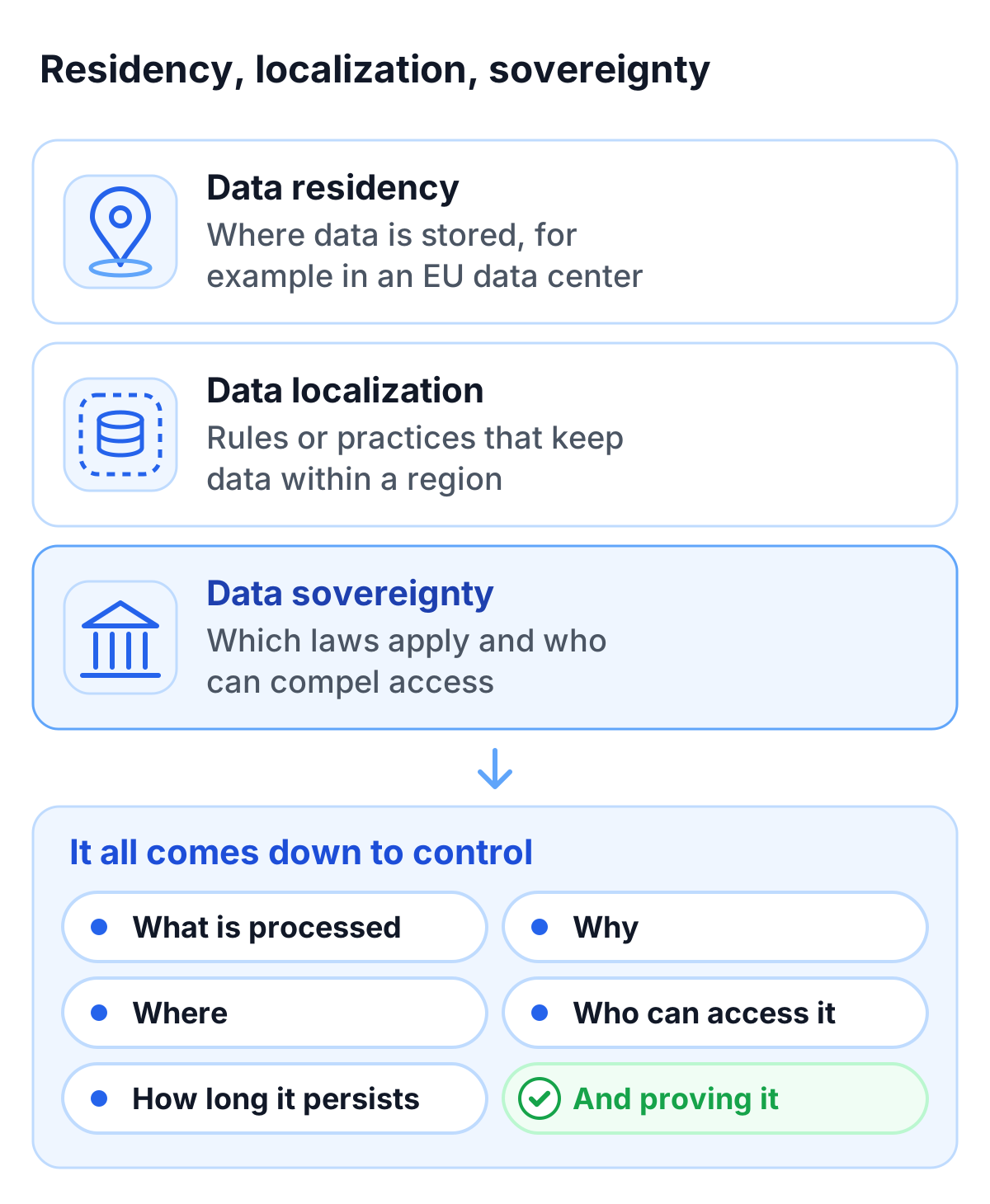
Data sovereignty is often discussed alongside two related terms: data residency and data localization. Although connected, they describe different constraints and therefore require different controls.
Data residency refers to where data is stored, such as an EU data center, an on-premise environment, or a specific country. Data localization is the practice or requirement of keeping certain categories of data within a jurisdiction’s physical or operational boundaries. Sovereignty focuses on legal authority and obligations, including regulatory expectations, lawful access rules, and the ability to demonstrate compliance and governance.
Sovereignty therefore comes down to one idea: control. Control means deciding what is processed, why, where, who can access it and how long it persists, and being able to prove all of that. Without control, “EU hosting” is a marketing phrase rather than a compliance and security position.
Why data sovereignty matters in real systems
Data sovereignty matters more now because digital services are becoming more distributed and more regulated at the same time. Organizations operate across borders, rely on cloud infrastructure, integrate multiple service providers, and deploy security tooling at critical points of user interaction. Each dependency can expand the legal and technical surface area of the data.
Sovereignty matters for privacy because users and regulators expect predictable legal protections. It matters for security because attackers do not respect borders, while incident response and forensic workflows must respect them. It matters for operations because availability and resilience depend on architecture choices that may be constrained by regional requirements. It also matters for trust, since end users increasingly judge a service by how it handles data, not just by its features.
The practical consequence: sovereignty is a design requirement. If it is not treated as one, it comes back later as an expensive remediation project, often triggered by a regulatory assessment, a vendor audit or a security incident.
Data sovereignty in the context of privacy compliance
Privacy laws and sector-specific regulations define obligations around purpose limitation, minimization, transparency, retention, and security. Data sovereignty intersects with these obligations by determining which legal framework applies and what enforcement mechanisms exist.
Consider a service that collects user credentials, billing details, or health-related information. Even when the service is headquartered outside Europe, processing EU users’ personal data typically triggers European legal duties. Meanwhile, if a third-party component processes data outside the EU, cross-border transfer obligations and additional governance steps may arise. The complexity increases when multiple jurisdictions overlap, and compliance has to work for all of them rather than for a single rule set.
Sovereignty-focused compliance is therefore a question of governance maturity: being able to map data flows, restrict processing to what is necessary, and show that controls work as described. This page explains the concepts; it is not legal advice, so check how they apply to you with your data protection officer.
How to enforce data sovereignty: practical strategies
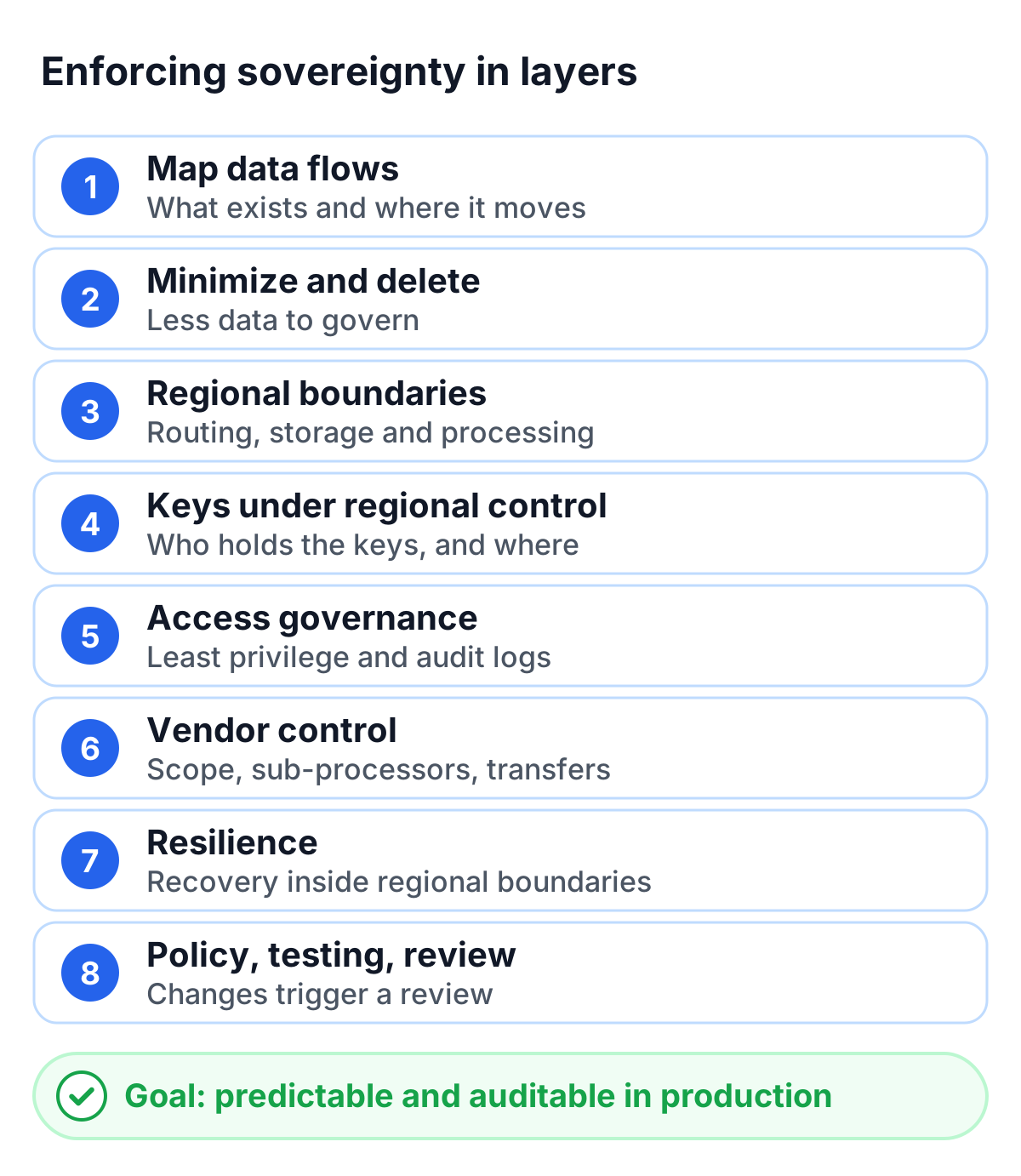
Data sovereignty is easiest to enforce as a layered control system. Legal commitments, technical measures, and operational procedures should reinforce each other. The aim is not only to be compliant on paper, but to be predictable and auditable in production.
1) Map data flows and attach legal meaning to data
Enforcement begins with visibility. Organizations need a data inventory that identifies what data exists, where it originates, what it contains, and which workflows touch it. A spreadsheet is not enough; it has to be a maintained picture of how data moves through systems and vendors. When that map is missing, sovereignty is assumed rather than enforced.
A useful approach is to link data categories to legal obligations and risk levels. Personal data, authentication signals, payment metadata, and security telemetry do not carry the same compliance or breach impact. Treating them as equivalent leads to collecting too much and controlling too little at the same time.
2) Minimize collection and reduce persistence by design
Sovereignty is easier to enforce when there is less data to govern. Minimization reduces cross-border transfer needs, decreases breach impact, and makes processing decisions easier to defend. Retention discipline is equally important: data that is not retained cannot be accessed later through compromise, misconfiguration, or compelled disclosure.
Minimization does not mean weak security telemetry. It means collecting the right signals for a defined purpose and deleting them as soon as they are no longer needed.
3) Engineer regional processing boundaries
Many sovereignty failures happen unintentionally through architecture. A system can store data in one region while processing it in another through centralized analytics, logging pipelines, or vendor APIs. Enforcement requires explicit boundaries: regional routing, regional storage, and regional processing. This includes ensuring that “background” data (such as logs, rate-limit telemetry, and fraud signals) follows the same regional policy as primary user data.
A practical pattern is segmentation by jurisdiction: deploy region-specific endpoints, region-scoped databases, and region-appropriate observability stacks. When global analysis is required, prefer aggregated or anonymized signals that do not reintroduce personal data into cross-border flows.
4) Keep cryptographic control within the intended jurisdiction
Encryption is usually discussed as a security control; for sovereignty, it is also a control over access. Strong encryption keeps data unusable without authorized keys, even if it is replicated or intercepted. So the question becomes: who controls the keys, where are they stored, and under what conditions can they be accessed?
Sovereignty-aligned designs typically aim to keep key management under regional control and to restrict administrative access through hardened processes. This is especially relevant when using managed services, where the line between “provider controls” and “customer controls” can become blurry without explicit contractual and technical arrangements.
5) Apply strict access governance and auditability
If sovereignty is about authority, then access is where that authority shows in practice. Organizations should implement role-based access controls, least privilege, and strong authentication for administrative actions. They should also keep tamper-evident audit logs for sensitive access and processing events, aligned with retention policies and incident response needs.
Auditability is what separates “we think we comply” from “we can prove we comply.”
6) Control cross-border transfer pathways and vendor dependencies
Third-party vendors can become silent data processors. Enforcement requires vendor assessment that is specific to data flows, not generic. A vendor can be “compliant” in general while still introducing cross-border transfer issues for a particular deployment.
Practical enforcement includes limiting vendor scope, requiring transparent sub-processor governance, restricting data categories that vendors may process, and documenting transfer mechanisms where required. Where possible, prefer vendors that process data in the EU for EU services to reduce transfer complexity and keep governance consistent.
7) Treat operational resilience as part of sovereignty
Sovereignty is not only about legal compliance; it is also about ensuring that critical services remain available and controllable under regional constraints. Disaster recovery and business continuity planning should respect regional data boundaries. Replication strategies should be designed so that resilience does not become a disguised transfer mechanism.
8) Institutionalize sovereignty through policy, testing, and review
Governance fails when it is written once and never revisited. Enforcement requires change management: new features, new analytics tools, new security vendors, and new regions must trigger review. Security testing and privacy impact assessments should include sovereignty checks: what data is created, where it goes, who can access it, and how long it persists.
The hidden sovereignty risk: third-party security layers on critical user journeys
A recurring blind spot in sovereignty programs is the security layer that sits closest to end users. Authentication protection, fraud detection, and bot mitigation often run on login, signup, password reset, checkout, and high-value forms. These flows involve some of the most sensitive user moments, and they generate signals that can be personally identifiable depending on context.
That creates a real conflict: organizations have to defend these flows against automated abuse, yet the defensive tools themselves can expand data processing scope. If a CAPTCHA or bot protection service relies on tracking-heavy mechanisms, broad device fingerprinting for unrelated purposes, or cross-border processing, it adds sovereignty problems exactly where the organization wants the most predictability. The reCAPTCHA GDPR and hCaptcha GDPR analyses show what that looks like for two widely used services.
A sovereignty-aligned approach keeps the bot protection and brings it in line with sovereignty principles: purpose limitation, minimization, regional processing and strong governance.
Why a data-sovereign CAPTCHA matters for cybersecurity
Credential stuffing, scripted account creation, scraping, and spam campaigns target the same endpoints that your compliance program cares about most. When bot traffic succeeds, it creates security incidents, privacy harm, and operational disruption. The defensive control (CAPTCHA or equivalent) is therefore a basic part of the security architecture.
The sovereignty question is whether that control can be deployed without introducing disproportionate data handling risk. A control should not solve one problem by creating another. A data-sovereign CAPTCHA lets security and compliance support each other: effective bot protection lowers breach risk, while processing in the EU and careful data handling keep the jurisdictional picture simple.
TrustCaptcha: data-sovereign bot protection
TrustCaptcha is designed as an invisible, no-interaction CAPTCHA alternative. It protects forms, logins, and transactional workflows from automated abuse without asking users to solve puzzles or complete friction-heavy challenges; the widget starts on its own. That helps security and user experience, and it helps sovereignty too: the less invasive and less persistent the mechanism, the easier it is to align with minimization and governance expectations.
For data sovereignty, the relevant facts are simple. TrustCaptcha sets no cookies, processes data in EU data centers and provides a Data Processing Agreement (DPA) for every customer. The company behind it, Trustcaptcha GmbH, is based in Munich, Germany. For a security function that touches a large share of your users, that removes cross-border transfers from the picture. Our GDPR-compliant CAPTCHA puts these points into practice, and the TrustCaptcha GDPR compliance guide has the detail for data protection officers.
To compare European providers, see our overview of EU CAPTCHA options.
TrustCaptcha is built around a narrow purpose: deciding whether an interaction is likely human or automated abuse, and reducing abuse while limiting data exposure.
A practical comparison: what changes when sovereignty is the goal
| Criterion | Traditional challenge CAPTCHA | Tracking-heavy “invisible” CAPTCHA | TrustCaptcha |
|---|---|---|---|
| User experience | Friction, puzzles, drop-offs | Often low friction | No interaction, no puzzles |
| Data posture | Varies; can be broad | Often broad, persistent, identity-like signals | Purpose-limited, minimized security signals |
| Transfer complexity | Depends on vendor region | Often includes cross-border processing | Processing in EU data centers |
| Security outcome | Can be bypassed, costly to users | Useful but can raise privacy concerns | Strong bot mitigation with governance-friendly design |
In practice, when a sovereignty program demands regional control and minimization, TrustCaptcha is a security layer that works with those constraints rather than against them.
Implementing data sovereignty with TrustCaptcha in your architecture
In sovereignty-aware deployments, bot protection works best as a scoped control, not a site-wide surveillance mechanism. TrustCaptcha supports this by focusing protection where it matters: authentication endpoints, account recovery flows, signup, checkout, and high-risk forms. This reduces the volume of processed signals while improving the security value of what is processed.
From a governance perspective, the goal is consistency: what your privacy documentation says about bot protection (its role, the data categories at a high level, the purpose and the retention logic) should match what runs in production, and your internal records should say the same. The wording is a question for your data protection officer; the TrustCaptcha GDPR compliance guide lists the facts for TrustCaptcha.
From a cybersecurity perspective, the goal is resilience: bot protection should integrate into monitoring, rate limiting, abuse analytics, and incident response. A sovereignty-aligned control is still a security control; it should produce usable results without leaving unnecessary data behind.
Data sovereignty enforcement checklist (practical, auditable controls)
A sovereignty program is strongest when it is measurable. The following control areas are commonly audited and operationally meaningful:
- Ensure processing locations and sub-processing are documented for each external dependency used in critical user journeys.
- Implement retention windows that reflect operational need, with automated cleanup.
- Ensure encryption in transit and governance over cryptographic keys for sensitive workflows.
- Apply strict administrative access controls with audit logs and reviewable evidence.
- Validate regional boundaries in observability pipelines (logs, metrics, traces) to avoid accidental transfers.
- Periodically re-evaluate configurations as features, regions, and laws evolve.
Next steps
If data sovereignty matters to your organization, treat bot protection as part of your sovereignty boundary. TrustCaptcha protects critical user journeys without puzzles, sets no cookies and processes data in EU data centers, so this part of your stack adds no transfer complexity.
Every plan comes with a 14-day free trial, and for questions about your setup you can contact us.