
'%3e%3crect%20width='32'%20height='24'%20fill='white'/%3e%3cpath%20fill-rule='evenodd'%20clip-rule='evenodd'%20d='M0%200V24H32V0H0Z'%20fill='%232E42A5'/%3e%3cmask%20id='mask0_270_67386'%20style='mask-type:luminance'%20maskUnits='userSpaceOnUse'%20x='0'%20y='0'%20width='32'%20height='24'%3e%3cpath%20fill-rule='evenodd'%20clip-rule='evenodd'%20d='M0%200V24H32V0H0Z'%20fill='white'/%3e%3c/mask%3e%3cg%20mask='url(%23mask0_270_67386)'%3e%3cpath%20d='M-3.56323%2022.2854L3.47846%2025.2635L32.1597%203.23787L35.874%20-1.18761L28.344%20-2.18297L16.6456%207.3085L7.22956%2013.7035L-3.56323%2022.2854Z'%20fill='white'/%3e%3cpath%20d='M-2.59924%2024.3719L0.988173%2026.1001L34.5402%20-1.59881H29.5031L-2.59924%2024.3719Z'%20fill='%23F50100'/%3e%3cpath%20d='M35.5631%2022.2854L28.5214%2025.2635L-0.159817%203.23787L-3.87415%20-1.18761L3.65593%20-2.18297L15.3543%207.3085L24.7703%2013.7035L35.5631%2022.2854Z'%20fill='white'/%3e%3cpath%20d='M35.3229%2023.7829L31.7355%2025.5111L17.4487%2013.6518L13.2129%2012.3267L-4.23151%20-1.17246H0.805637L18.2403%2012.0063L22.8713%2013.5952L35.3229%2023.7829Z'%20fill='%23F50100'/%3e%3cmask%20id='path-7-inside-1_270_67386'%20fill='white'%3e%3cpath%20fill-rule='evenodd'%20clip-rule='evenodd'%20d='M19.7777%20-2H12.2222V8H-1.97253V16H12.2222V26H19.7777V16H34.0275V8H19.7777V-2Z'/%3e%3c/mask%3e%3cpath%20fill-rule='evenodd'%20clip-rule='evenodd'%20d='M19.7777%20-2H12.2222V8H-1.97253V16H12.2222V26H19.7777V16H34.0275V8H19.7777V-2Z'%20fill='%23F50100'/%3e%3cpath%20d='M12.2222%20-2V-4H10.2222V-2H12.2222ZM19.7777%20-2H21.7777V-4H19.7777V-2ZM12.2222%208V10H14.2222V8H12.2222ZM-1.97253%208V6H-3.97253V8H-1.97253ZM-1.97253%2016H-3.97253V18H-1.97253V16ZM12.2222%2016H14.2222V14H12.2222V16ZM12.2222%2026H10.2222V28H12.2222V26ZM19.7777%2026V28H21.7777V26H19.7777ZM19.7777%2016V14H17.7777V16H19.7777ZM34.0275%2016V18H36.0275V16H34.0275ZM34.0275%208H36.0275V6H34.0275V8ZM19.7777%208H17.7777V10H19.7777V8ZM12.2222%200H19.7777V-4H12.2222V0ZM14.2222%208V-2H10.2222V8H14.2222ZM-1.97253%2010H12.2222V6H-1.97253V10ZM0.0274658%2016V8H-3.97253V16H0.0274658ZM12.2222%2014H-1.97253V18H12.2222V14ZM14.2222%2026V16H10.2222V26H14.2222ZM19.7777%2024H12.2222V28H19.7777V24ZM17.7777%2016V26H21.7777V16H17.7777ZM34.0275%2014H19.7777V18H34.0275V14ZM32.0275%208V16H36.0275V8H32.0275ZM19.7777%2010H34.0275V6H19.7777V10ZM17.7777%20-2V8H21.7777V-2H17.7777Z'%20fill='white'%20mask='url(%23path-7-inside-1_270_67386)'/%3e%3c/g%3e%3c/g%3e%3cdefs%3e%3cclipPath%20id='clip0_270_67386'%3e%3crect%20width='32'%20height='24'%20fill='white'/%3e%3c/clipPath%3e%3c/defs%3e%3c/svg%3e)
'%3e%3crect%20width='32'%20height='24'%20fill='white'/%3e%3cpath%20fill-rule='evenodd'%20clip-rule='evenodd'%20d='M0%2016H32V24H0V16Z'%20fill='%23FFD018'/%3e%3cpath%20fill-rule='evenodd'%20clip-rule='evenodd'%20d='M0%208H32V16H0V8Z'%20fill='%23E31D1C'/%3e%3cpath%20fill-rule='evenodd'%20clip-rule='evenodd'%20d='M0%200H32V8H0V0Z'%20fill='%23272727'/%3e%3c/g%3e%3cdefs%3e%3cclipPath%20id='clip0_270_67353'%3e%3crect%20width='32'%20height='24'%20fill='white'/%3e%3c/clipPath%3e%3c/defs%3e%3c/svg%3e)
'%3e%3crect%20width='32'%20height='24'%20fill='white'/%3e%3cpath%20fill-rule='evenodd'%20clip-rule='evenodd'%20d='M22%200H32V24H22V0Z'%20fill='%23F50100'/%3e%3cpath%20fill-rule='evenodd'%20clip-rule='evenodd'%20d='M0%200H12V24H0V0Z'%20fill='%232E42A5'/%3e%3cpath%20fill-rule='evenodd'%20clip-rule='evenodd'%20d='M10%200H22V24H10V0Z'%20fill='%23F7FCFF'/%3e%3c/g%3e%3cdefs%3e%3cclipPath%20id='clip0_270_67361'%3e%3crect%20width='32'%20height='24'%20fill='white'/%3e%3c/clipPath%3e%3c/defs%3e%3c/svg%3e)
What is the best Atlassian Statuspage alternative?

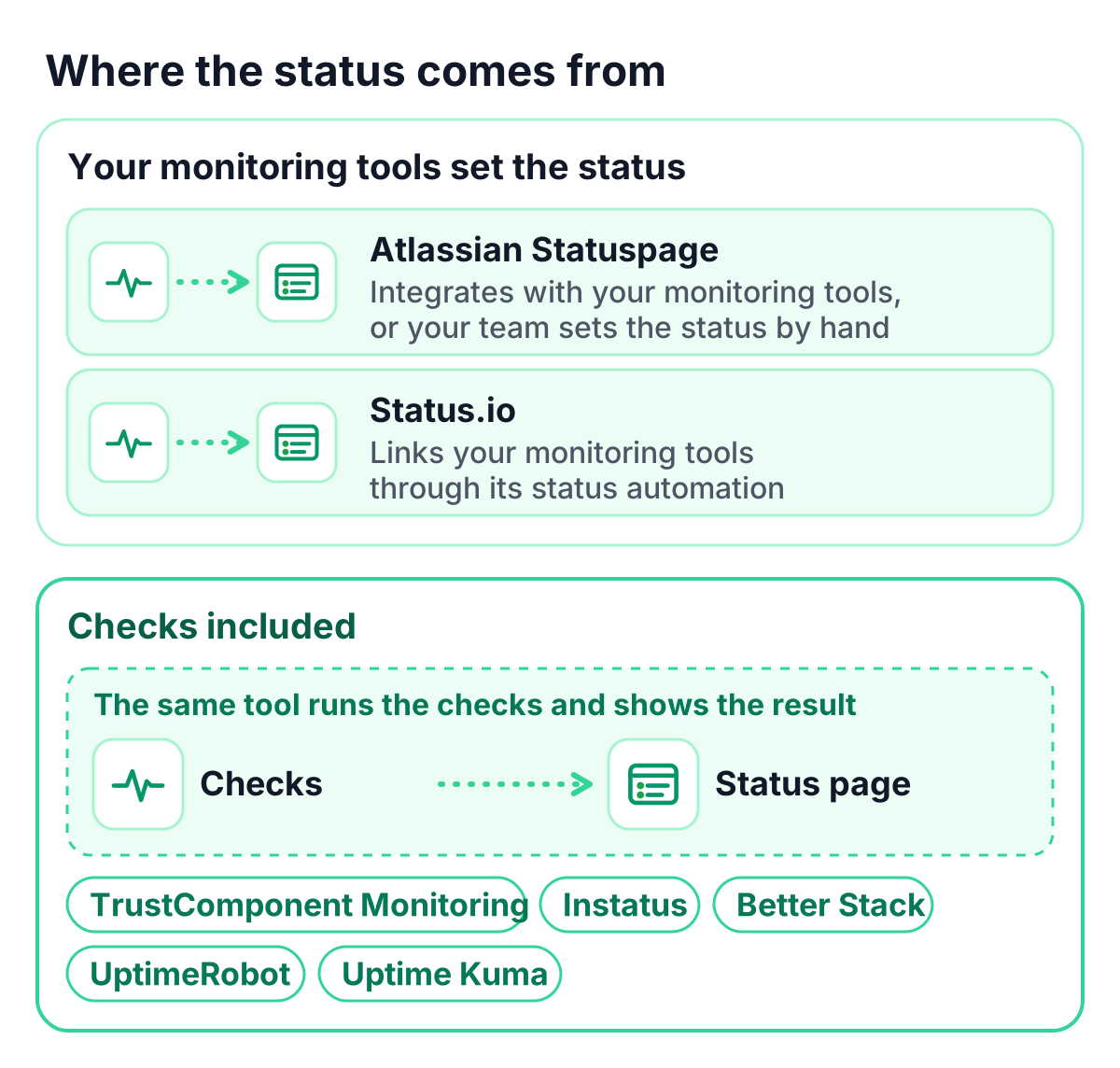
That depends on why you are leaving Atlassian Statuspage. Atlassian’s documentation says Statuspage does not ping your servers or endpoints: the status it shows comes from monitoring and alerting tools you connect, or from your team. If you want the checks and the status page in one product, look at TrustComponent Monitoring, Instatus, Better Stack or UptimeRobot. If your monitoring stays where it is and you only want a different hosted page, Status.io is a hosted status page that links the monitoring tools you already use. And if you would rather run everything yourself, Uptime Kuma is open source and self-hosted.
Price is the other common reason. Statuspage sizes its plans by subscribers, team members and metrics, from a free plan with 100 subscribers to Enterprise at $1,499 a month with 25,000. The status page alternatives in this list use other structures: TrustComponent Monitoring and UptimeRobot price by the number of monitors, Better Stack charges per responder license, and Instatus sells flat plans without per-seat fees.
Atlassian Statuspage alternatives compared
The table puts the six side by side, with Atlassian Statuspage as the reference in the last row.
| Uptime monitoring | Free plan and entry price | Custom domain | Data protection | |
|---|---|---|---|---|
| TrustComponent Monitoring | Included: HTTP, ping and TCP on Free, up to 16 check types on paid plans | Free plan with 10 monitors and a status page; Solo from €9 a month | From Solo | EU data centers, GDPR-compliant |
| Instatus | Included: 15 monitors with 2-minute checks on Starter, 50 with 30-second checks on Pro | Free Starter plan; Pro $20 a month billed monthly | From Pro | Varies, needs legal review |
| Status.io | Links external monitoring tools to set component status | Basic $79 a month; Enterprise from $999 a month | On every plan | Varies, needs legal review |
| Better Stack | Included: 10 monitors and 10 heartbeats with 3-minute checks on the free plan | Free plan for personal projects; $34 per responder license a month billed monthly, $29 billed annually | Custom sub-domain | EU regions by default; its DPA allows transfers to the USA |
| UptimeRobot | Included: 50 monitors at 5-minute intervals on Free | Free plan; Solo from €10 a month billed monthly, €9 billed annually | From Solo; Free uses an UptimeRobot URL | Primary processing in the EU, secondary in the USA |
| Uptime Kuma | Included and self-hosted, with 20-second intervals | Free open-source software (MIT license); you pay for your own hosting | Status pages map to your own domains | Wherever you host it |
| Atlassian Statuspage (for comparison) | Not included; integrates with monitoring and alerting tools | Free plan; Hobby $29 a month | Listed on Hobby and higher | Varies, needs legal review |
Prices per month. TrustComponent prices are in euros and exclude VAT. UptimeRobot shows euro prices to visitors from euro regions; visitors elsewhere may see a different currency and amount. Instatus gives three months free when you pay for a year up front, and Status.io takes 5% off annual subscriptions.
Why teams look for an Atlassian Statuspage alternative
Statuspage covers the basics of incident communication on every plan: incidents, components and component groups, scheduled maintenances, incident templates, page analytics, a status embed and REST API access. Its free plan includes 100 subscribers, 25 components, two team members and notifications by email, Slack and Microsoft Teams. Beyond public pages, Atlassian sells private pages from $79 a month and audience-specific pages from $300 a month. On Startup and higher plans, team members sign in with single sign-on through Atlassian Guard at no extra charge, which helps teams that already manage their Atlassian accounts that way.
Three points lead teams to look elsewhere:
- Monitoring is a second tool. Atlassian’s documentation says Statuspage doesn’t ping your servers or endpoints; it integrates with monitoring and alerting tools to automate component status. Without such an integration, your team sets each component’s status by hand.
- Subscribers set the plan. Hobby at $29 a month includes 250 subscribers and email notifications. SMS and webhook notifications start with Startup at $99 a month and 1,000 subscribers, and Business at $399 a month includes 5,000. Our article on Atlassian Statuspage pricing goes through every plan.
- Data location. Statuspage is provided by Atlassian Pty Ltd, a company registered in Australia. Where your subscriber data is hosted is a question for your legal review.
What to compare in a status page alternative
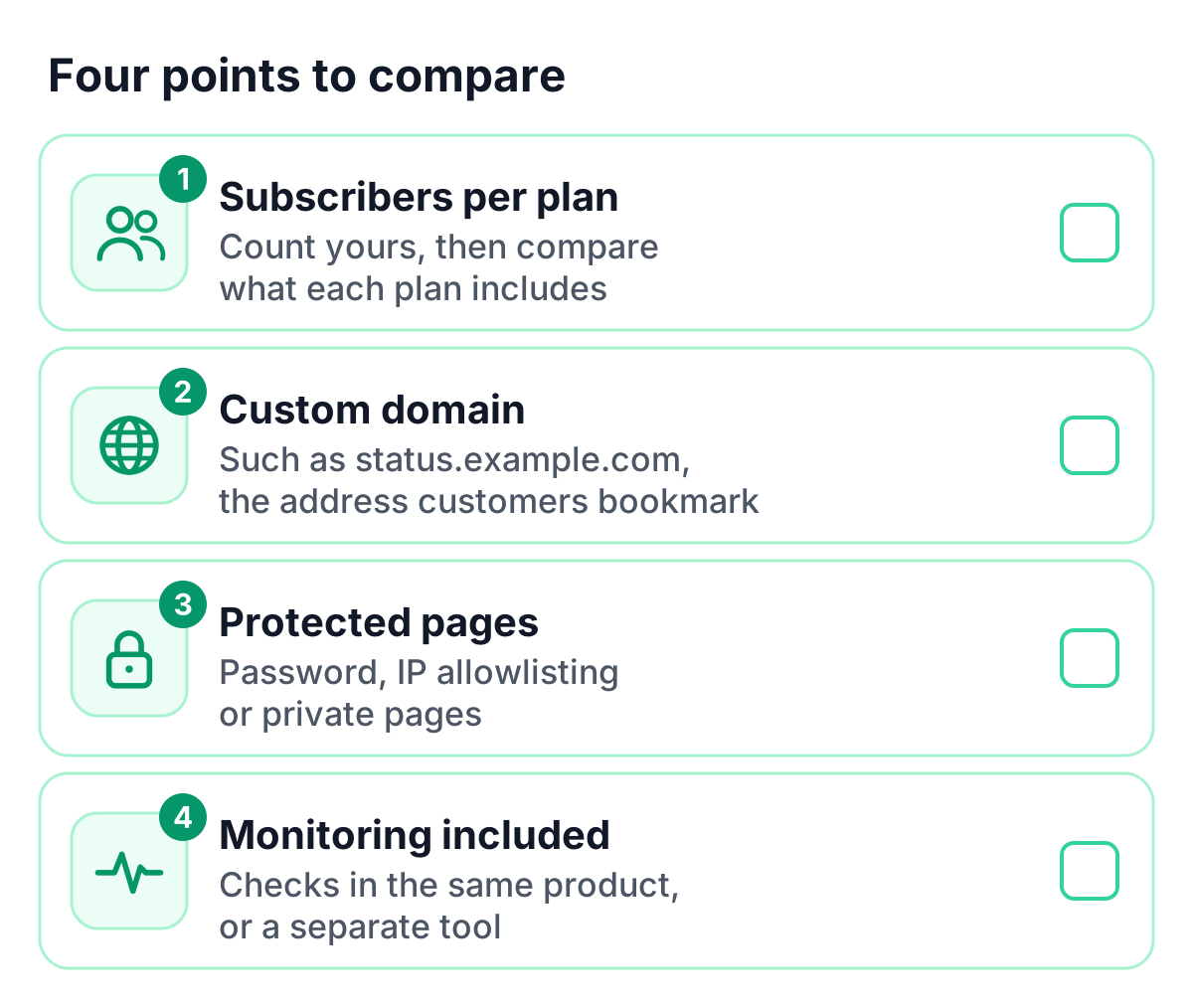
Four points decide most moves away from Statuspage: how many subscribers a plan includes, whether your custom domain comes along, how protected pages are priced, and whether monitoring is part of the product.
Subscribers. Count the subscribers you have today, then compare what each hosted tool includes:
| Tool | Subscribers included |
|---|---|
| Atlassian Statuspage | Free 100, Hobby 250, Startup 1,000, Business 5,000, Enterprise 25,000 |
| TrustComponent Monitoring | Team 500, Enterprise 2,500; unlimited on a custom plan |
| Instatus | Starter 200, Pro 5,000, Business 25,000 |
| Status.io | Basic 500, Standard 2,000, Plus 5,000 |
| Better Stack | 1,000 included; each additional 1,000 for $40 a month |
| UptimeRobot | On the Team and Scale plans |
Custom domain. Your status subdomain, such as status.example.com, is the address customers bookmark. TrustComponent Monitoring and UptimeRobot include a custom domain from Solo, Instatus from Pro and Status.io on every plan. Better Stack lists a custom sub-domain among its status page features, and Uptime Kuma maps status pages to your own domains.
Protected pages. Prices for internal and partner pages vary widely. Statuspage sells private pages from $79 a month (Starter, with 50 authenticated subscribers) and adds IP allowlisting with Growth at $249. TrustComponent Monitoring covers password and IP access control and white-label with the Status Page Pro add-on at €79 a month. Better Stack charges per page and month: $50 for password protection and $250 each for IP allowlisting and white-label, billed monthly ($42 and $208 billed annually). UptimeRobot includes password protection and white-label from Team, and Instatus includes all status page types on Business. Which page fits which audience is covered in our status page examples.
Monitoring. TrustComponent Monitoring, Instatus, Better Stack, UptimeRobot and Uptime Kuma run their own checks, so the checks and the status page live in one product. Status.io’s status automation links your monitoring tools to set component status.
The six Atlassian Statuspage alternatives
1. TrustComponent Monitoring
TrustComponent Monitoring runs uptime checks and hosts your status pages in the same product. An outage creates a pre-filled incident draft, and nothing is published until someone on your team decides. The Free plan includes 10 monitors and one status page. Solo costs €9 a month for 10 monitors and adds three status pages on your own domain with your branding, and Team at €39 a month adds ten status pages and subscribers, with 500 included. Status pages come in 10 languages on every plan, and all data is stored and processed in the EU.
It suits EU teams that want monitoring and the status page in one tool, with up to 16 check types, checks as often as every 30 seconds on Enterprise and a data processing agreement they can sign online. Watch for the plan limits: subscribers start with Team, white-label and password or IP access need the Status Page Pro add-on at €79 a month, and Free checks every 5 minutes from one location. Prices exclude VAT.
2. Instatus
Instatus is a status page tool with monitors included in every plan. The free Starter plan has 15 monitors with 2-minute checks, email alerts, five team members, a public status page and 200 subscribers. Pro costs $20 a month billed monthly and adds 50 monitors with 30-second checks, email and SMS alerts, 50 team members, a custom domain and 5,000 subscribers. Business goes up to 1,000 monitors, phone-call alerts, SAML SSO, all status page types, three or more custom domains and 25,000 subscribers. Instatus describes its pricing as flat, with no per-seat fees.
It suits teams that want a status page with built-in monitoring and a large subscriber allowance at a fixed monthly price. Watch for the free plan: Starter has no custom domain.
3. Status.io
Status.io is a hosted status page with three plans: Basic at $79 a month, Standard at $149 and Plus at $349, with Enterprise plans from $999 a month and 5% off annual subscriptions. Every plan includes one public status page, a custom domain, a TLS subdomain, multi-factor authentication, a developer API and 24/7 human support. Subscribers range from 500 on Basic to 5,000 on Plus, and team members from 5 to 50. SMS notifications go out through Twilio or Vonage.
It suits teams that already run monitoring elsewhere and want a dedicated status page with a custom domain and round-the-clock human support on every plan. Watch for how status gets onto the page: Status.io’s status automation links the monitoring tools you use to toggle component status, and each plan includes one public status page.
4. Better Stack
Better Stack combines uptime monitoring, incident management, on-call and status pages. Its free plan, labelled for personal projects, includes 10 monitors, 10 heartbeats and a status page with 3-minute checks. Paid use is billed per responder license, at $34 a month billed monthly or $29 billed annually, with unlimited phone-call and SMS alerts, and team members are free. One status page and 1,000 subscribers are included; each further public status page costs $15 a month ($12 billed annually) and each further 1,000 subscribers $40 a month. Better Stack stores data in EU regions by default and lists SOC 2 Type II compliance.
It suits teams that want monitoring, on-call and status pages in one product, with checks from multiple regions as often as every 30 seconds. Watch for the per-page add-ons, billed per page and month: white-label $250, password protection $50, IP allowlisting $250, SSO $250, emails from your own domain $250 and custom CSS and JavaScript $15 ($208, $42, $208, $208, $208 and $12 billed annually). Its DPA allows transfers to the USA and other locations.
5. UptimeRobot
UptimeRobot is an uptime monitoring service from Bratislava in Slovakia, with status pages on every plan. The Free plan includes 50 monitors at 5-minute intervals and one status page on an UptimeRobot URL. Solo costs €10 a month billed monthly or €9 billed annually for 10 monitors, checks every 60 seconds and adds three status pages on your own domain. Team, at €41 a month billed monthly or €35 billed annually, adds 100 status pages with white-label, password protection and subscribers, and Scale has unlimited status pages. Status pages are available in 11 languages.
It suits teams whose main need is uptime monitoring and who want status pages on top, starting with 50 free monitors. Watch for the plan gates: subscribers and password-protected pages start with Team. Its DPA names the EU as the primary processing location and the USA as secondary. If you are weighing UptimeRobot itself, see our UptimeRobot alternatives.
6. Uptime Kuma
Uptime Kuma is an open-source, self-hosted monitoring tool under the MIT license. It checks HTTP(S), TCP, keywords, JSON queries, WebSockets, ping, DNS records, push monitors, Steam game servers and Docker containers at 20-second intervals. Notifications go out through more than 90 services, among them Telegram, Discord, Slack and email, and you can run multiple status pages and map them to your own domains. It runs with Docker or Node.js.
It suits teams that want full control over code and data and already run their own infrastructure. Watch for the work that comes with it: you run, update and secure it yourself, and its checks come from wherever you deploy it, so it should run apart from the systems it watches. Our guide to open source status pages weighs self-hosting against a hosted service.
Moving your status page from Atlassian Statuspage
Plan the move so customers never land on an empty page:
- List what you have. Note your components and component groups, scheduled maintenances, team members and the integrations that set component status today.
- Rebuild components and monitors. Create the components on the new page. With a tool that includes monitoring, set up the monitors first and group them into the components your customers know. In TrustComponent Monitoring you create monitors and status page services yourself; there is no import from other tools.
- Invite subscribers again. Post a notice on your old page, link the new page’s subscription form and give subscribers time to sign up. Copying email addresses from one tool into another is a data protection question. This is not legal advice, so check it with your data protection officer.
- Keep your incident history. Save past incidents and maintenance notes before you cancel, for SLA reviews and customer questions. Statuspage includes REST API access on every plan.
- Switch the custom domain. Add your status subdomain in the new tool, then change its DNS record as the new tool describes; for TrustComponent Monitoring that is a CNAME. Keep the old page running until the new one answers on your domain with a valid certificate.
- Cancel last. Once the new page runs on your domain and your subscribers have moved, close the old account.
How TrustComponent Monitoring fits
If you are leaving Statuspage because you want the checks and the status page in one tool, a typical Statuspage setup maps onto TrustComponent Monitoring like this:
- A public page on your own domain: Solo at €9 a month, with 10 monitors and three status pages.
- A page with subscribers: Team at €39 a month, with 100 monitors, ten status pages and 500 subscribers, or Enterprise from €79 a month, with 100 status pages and 2,500 subscribers.
- Internal, partner or white-label pages: the Status Page Pro add-on at €79 a month adds password and IP access control and white-label.
- More than 500 monitors: a custom plan with unlimited status pages and subscribers.
All prices exclude VAT. Monitoring data is stored and processed in the EU, with a GDPR data processing agreement you can sign online. The status page features show what each page can do.
Atlassian Statuspage, Instatus, Status.io, Better Stack, UptimeRobot, Uptime Kuma and the other product names mentioned are trademarks of their respective owners. TrustComponent is not affiliated with them.
Get started
TrustComponent Monitoring’s Free plan includes 10 monitors and a status page, with no credit card required, and every paid plan starts with a 14-day free trial. Compare the Monitoring plans and build your new status page next to Statuspage before you switch the domain.