Introduction
Reverse engineering, also known as back engineering, is a technical process for working out the structure and function of an existing product, system or piece of software. It is used in cybersecurity and product development, and intelligence agencies rely on it as well. It helps solve problems and drives innovation, and it also raises ethical and legal questions. Both sides matter: how reverse engineering works, and where its limits are.
What is reverse engineering and why is it used?
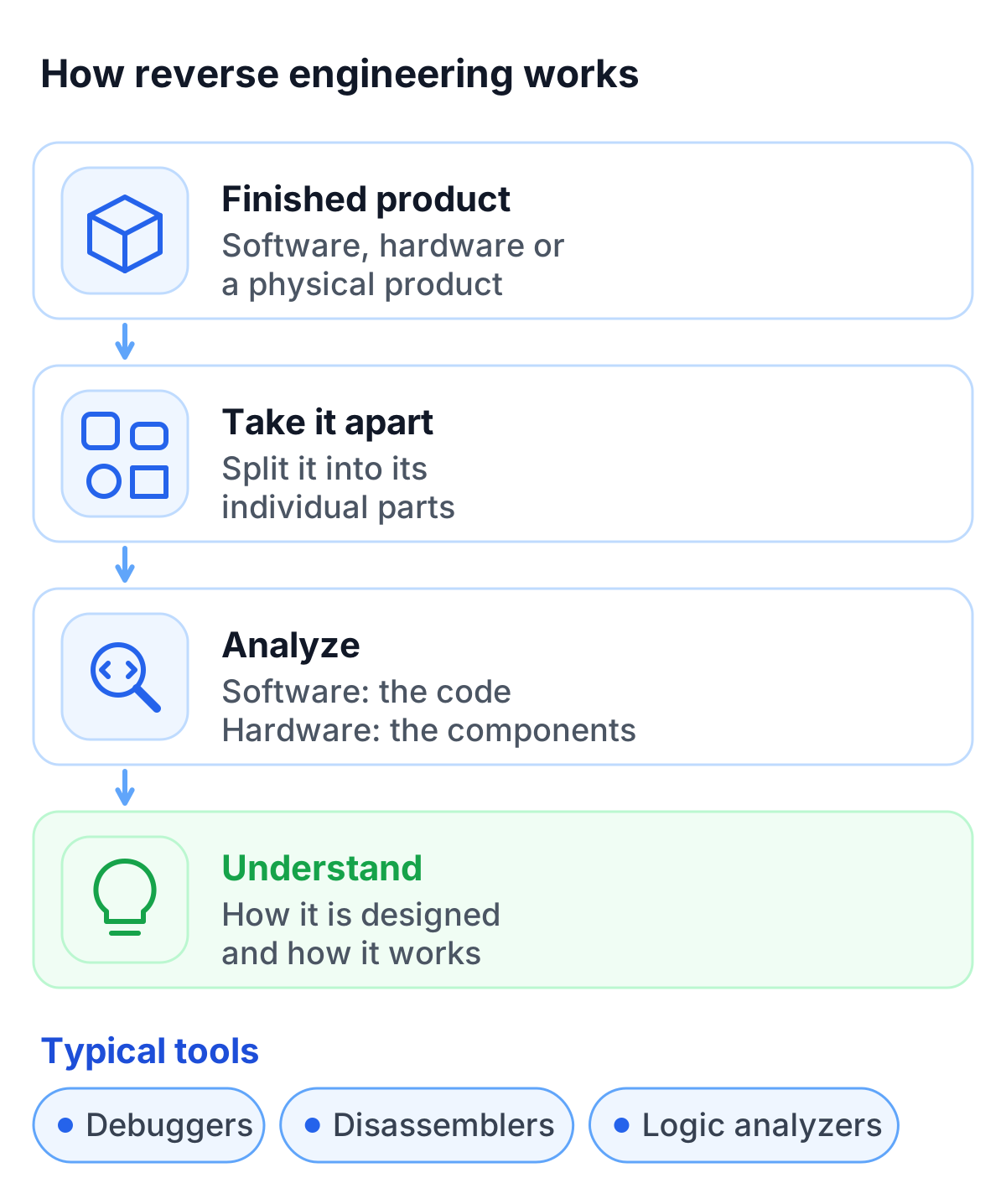
Reverse engineering describes the process of disassembling or analyzing a finished product to understand its design and functionality. It is used in software development to reconstruct old programs, in hardware to trace technical components, and in physical products to analyze their construction or material composition.
Applications
- Product development: Companies use reverse engineering to understand how competitors’ products work and build their own products on what they learn.
- Cybersecurity: Security researchers analyze malware to understand its mechanisms and develop protective measures.
- Technology restoration: Reverse engineering is used to update or understand outdated or undocumented systems.
How it works
Reverse engineering usually starts by taking the target apart. With software, the analyst usually has no source code, so they study the compiled program and its behavior; with hardware, they examine the physical components. Typical tools are debuggers, disassemblers and logic analyzers.
The role of intelligence agencies
Intelligence agencies like the NSA use reverse engineering as a strategic tool, where cybersecurity, espionage and technology development overlap.
One of their main tasks is to examine foreign technology. Reverse engineering lets them uncover hidden functions or backdoors in software or hardware, for example in telecommunication devices that may carry security risks. It also matters for defense against cyberattacks: agencies take malware apart to understand how it attacks and to build countermeasures. Stuxnet is the best-known case. Security researchers analyzed it in detail to work out how it sabotaged industrial controllers.
The use of reverse engineering by intelligence agencies is not without controversy. Critics accuse organizations like the NSA of using technology not only for protection but also for offensive cyber operations. This can heighten international tensions and raise ethical questions.
Reverse engineering and hackers
Ethical and malicious hackers both use reverse engineering. The methods are often the same; the goals are not.
White-hat hackers use reverse engineering to find security vulnerabilities in software and report them to the developers, so the holes get fixed before someone exploits them. For instance, ethical hackers regularly analyze new malware to mitigate its effects. On the other hand, black-hat hackers use reverse engineering to exploit vulnerabilities in software or networks. This analysis can lead to the development of exploits that allow data theft, system compromise, or the creation of malware such as ransomware. Bot operators analyze the spam protection on web forms in the same way; the article on how bots bypass CAPTCHAs shows the tools they use.
Famous examples
- Stuxnet: Researchers reverse engineered this unusually complex malware to understand how it damaged its targets.
- Ransomware decryption: Security experts use reverse engineering to break ransomware encryption and help victims recover their data.
Legal and ethical aspects
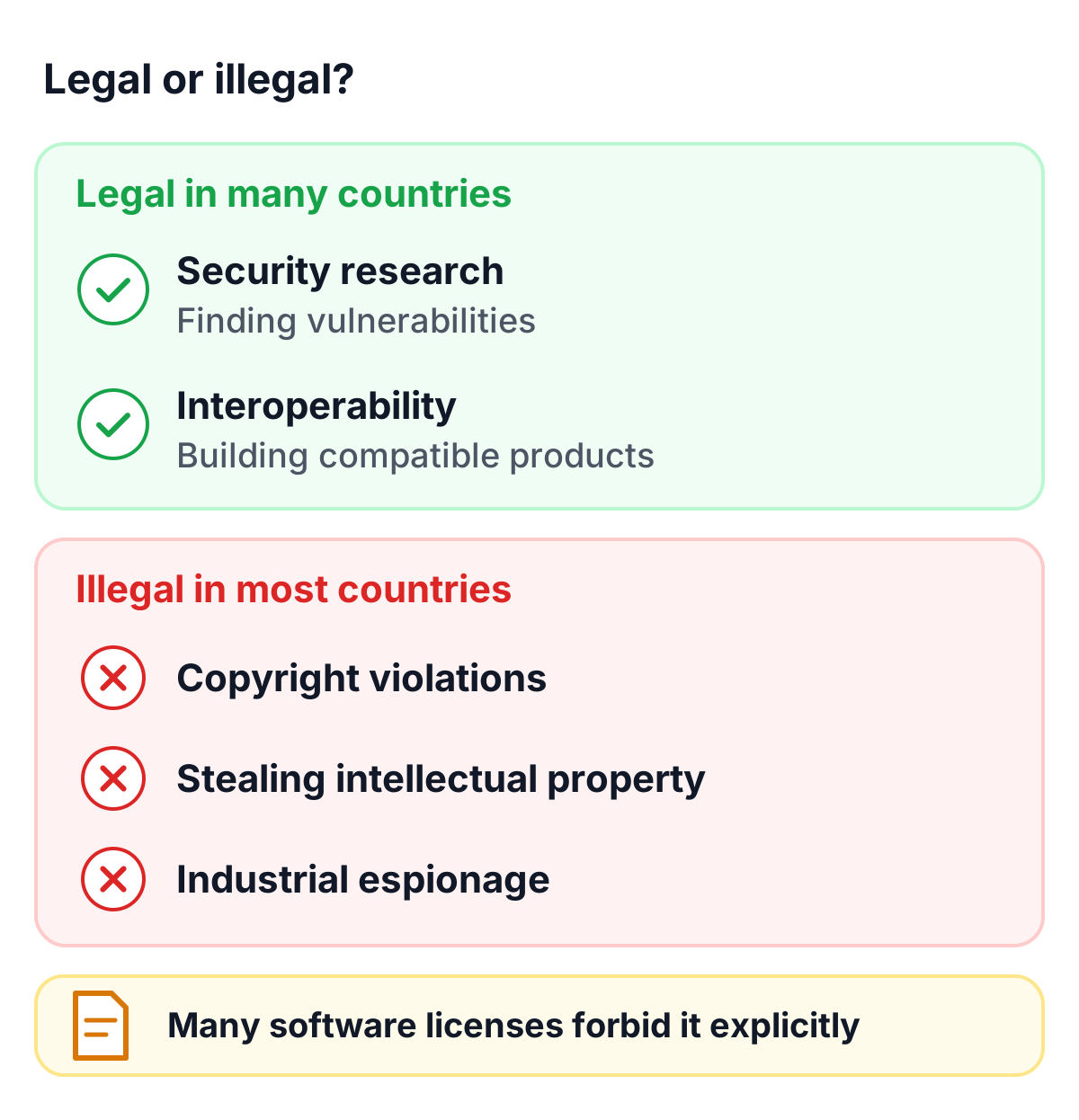
Whether reverse engineering is legal and acceptable usually depends on why someone does it. In many countries it is legal for legitimate purposes, such as:
- Security research: Analyzing software to identify vulnerabilities.
- Interoperability: Developing compatible products without relying on original documentation.
The boundaries of legality are often blurred. Reverse engineering that violates copyrights, steals intellectual property, or engages in industrial espionage is illegal in most countries. Furthermore, many licensing agreements explicitly prohibit the reverse engineering of software.
Legal does not always mean uncontroversial. Security interests and the protection of intellectual property often pull in different directions. One long-running debate: should security researchers publish a vulnerability before they have told the manufacturer?
Benefits and challenges
Reverse engineering improves products and security, and it also carries risks.
Benefits
- Driving innovation: Analyzing existing technologies can lead to the development of new products.
- Enhancing security: Reverse engineering helps identify and fix vulnerabilities in systems.
- Restoring obsolete technologies: Systems without documentation can be made usable again through reverse engineering.
Challenges
- Technical complexity: Modern systems employ encryption and protections that complicate reverse engineering.
- Legal uncertainty: Variations in legal frameworks across countries can create issues.
- Risk of misuse: In the wrong hands, reverse engineering can be used for destructive purposes.
Conclusion
Reverse engineering works by taking a finished product apart until its design and behavior are clear. Security teams use it to understand malware and find vulnerabilities, companies use it to keep old systems running and to learn from competitors, and attackers use the same techniques to build exploits or to defeat the spam protection on web forms. Whether it is legal depends on the purpose, the country and the license. If you plan to analyze someone else’s software, read the license first.