


WordPress CAPTCHA Plugin
Our WordPress CAPTCHA plugin secures forms, comments, logins and the WooCommerce checkout against spam and bots, without image puzzles. It works with popular plugins like Elementor Forms, Contact Form 7, Gravity Forms, Ninja Forms and WPForms. EU-hosted and GDPR-compliant.
Quickstart
How the integration works
1. Create a CAPTCHA
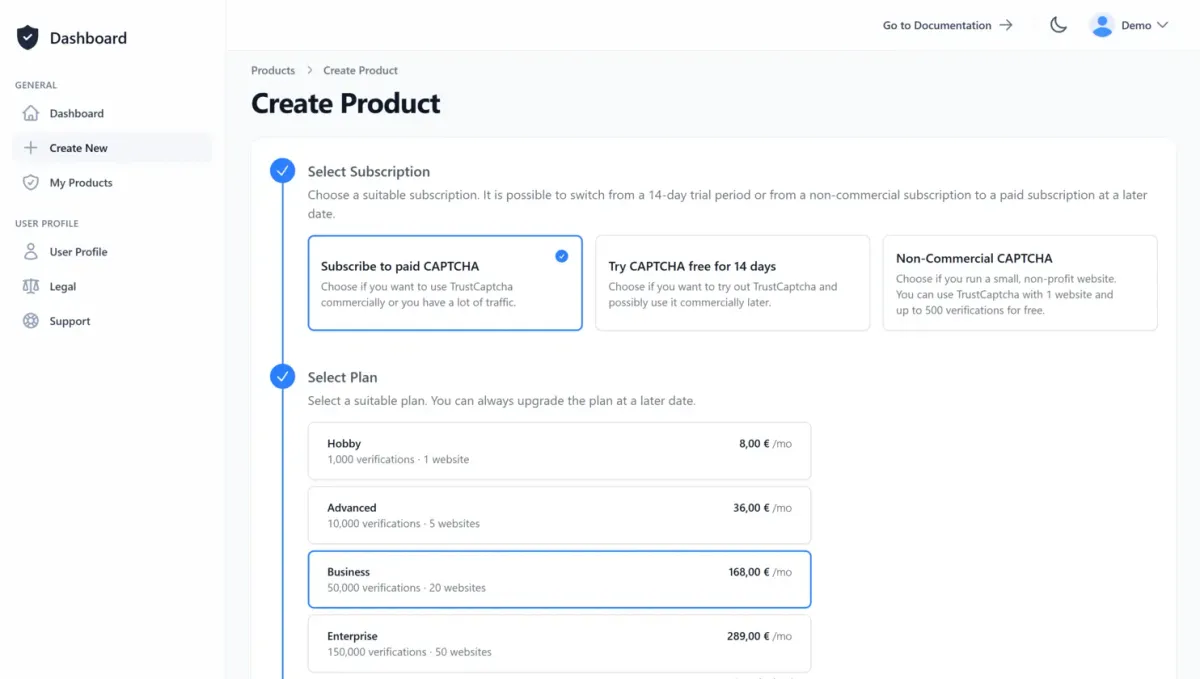
Create a user account or log in with an existing one. Then create a new CAPTCHA or pick an existing one. If you want to try TrustCaptcha first, every plan comes with a 14-day free trial.
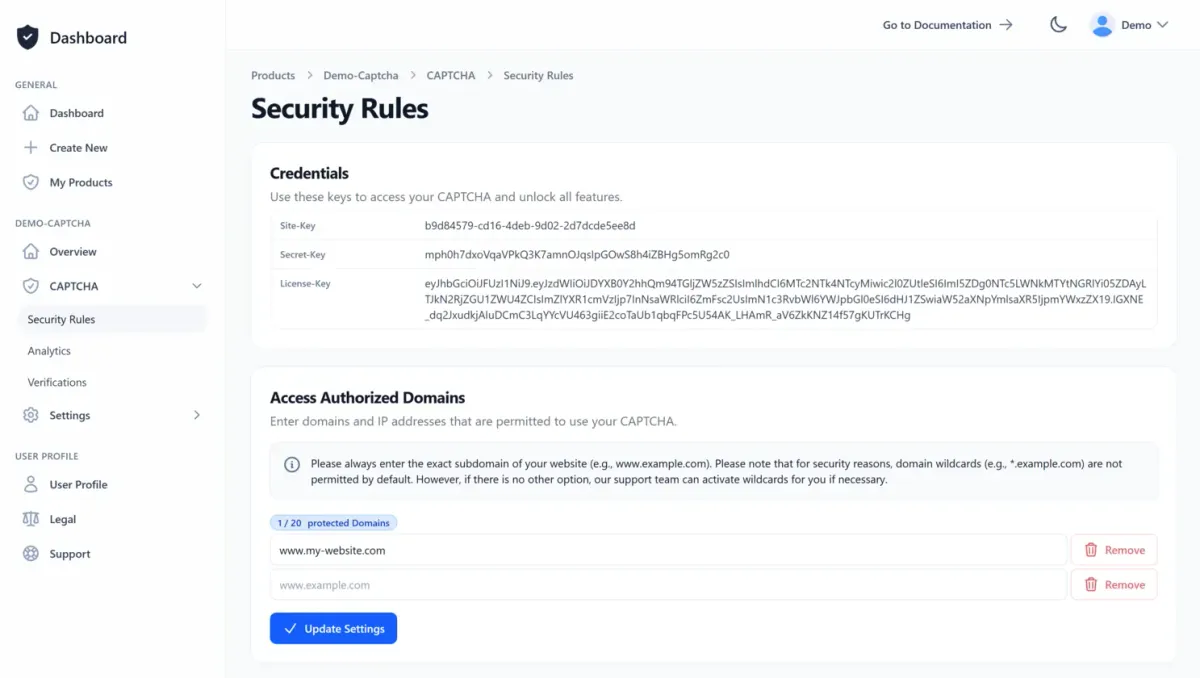
The CAPTCHA overview page shows your site key and license key, and you create your API key there. Add your website’s domains to the authorized domains in the CAPTCHA security rules so they can use your CAPTCHA.
2. Integrate the CAPTCHA Plugin
Install the TrustCaptcha WordPress plugin via the WordPress plugin directory (recommended) or download our plugin here and install it manually. For step-by-step instructions, read the CAPTCHA integration guide for WordPress in our documentation.
Read the documentation
Our WordPress CAPTCHA plugin adds a CAPTCHA to the WordPress forms, WooCommerce, bbPress and the popular form plugins. Each of them has its own section further down this page.
Other frontend technology instead of WordPress?
If you build with something other than WordPress, or run several websites and apps, pick a different framework or platform here. If we have no pre-built integration for your frontend technology yet, your developers can integrate the CAPTCHA themselves using our documentation or ask our support team for a pre-built integration.

;}.cls-3{fill:%2333c6f4;}.cls-4{fill:%231b447e;}.cls-5{fill:%23fff;}.cls-6{stroke:%23221e1f;stroke-miterlimit:10;stroke-width:7.16px;}%3c/style%3e%3cclipPath%20id='clip-path'%20transform='translate(1.72)'%3e%3ccircle%20class='cls-1'%20cx='119.73'%20cy='119.73'%20r='116.15'/%3e%3c/clipPath%3e%3c/defs%3e%3cg%20id='Layer_2'%20data-name='Layer%202'%3e%3cg%20id='Layer_1'%20data-name='Layer%201'%3e%3cg%20class='cls-2'%3e%3ccircle%20class='cls-3'%20cx='121.45'%20cy='119.73'%20r='116.15'/%3e%3cpath%20class='cls-4'%20d='M239.32,167.79c-53.41-24-108.37-91.46-113-94.55s-10.84.77-10.84.77c-3.87-6.19-10.06.77-10.06.77C76.77,123.55.14,170.11.14,170.11S36.94,237.79,122,237.79C208.48,237.79,239.32,167.79,239.32,167.79Z'%20transform='translate(1.72)'/%3e%3cpath%20class='cls-5'%20d='M67.48,116.58s15.48-7,12.38,4.65-15.48,28.64-11.61,29.41S83,140.58,86.06,142.12s5.42.78,3.87,6.2-3.1,9.29,0,9.29,5.42-7,9.29-13.94,10.06-3.87,12.38-1.55,9.29,15.49,14.71,13.94,8.51-8.52,6.19-24,1.55-20.12,1.55-20.12,4.64-2.32,13.16,8.51,24,27.09,26.31,26.32-10.83-17.8-7.74-19.35,15.48,2.32,21.68,7.74c0,0,2.12,8.87,2.12.36L126.31,73.24,115.47,74l-10.06.77S80.64,111.94,67.48,116.58Z'%20transform='translate(1.72)'/%3e%3cpath%20class='cls-6'%20d='M239.32,170.11c-53.41-24-108.37-93.78-113-96.87s-10.84.77-10.84.77c-3.87-6.19-10.06.77-10.06.77C76.77,123.55.14,170.11.14,170.11'%20transform='translate(1.72)'/%3e%3c/g%3e%3ccircle%20class='cls-6'%20cx='121.45'%20cy='119.73'%20r='116.15'/%3e%3c/g%3e%3c/g%3e%3c/svg%3e)


'/%3e%3c/svg%3e)


3. Configure the TrustCaptcha Plugin
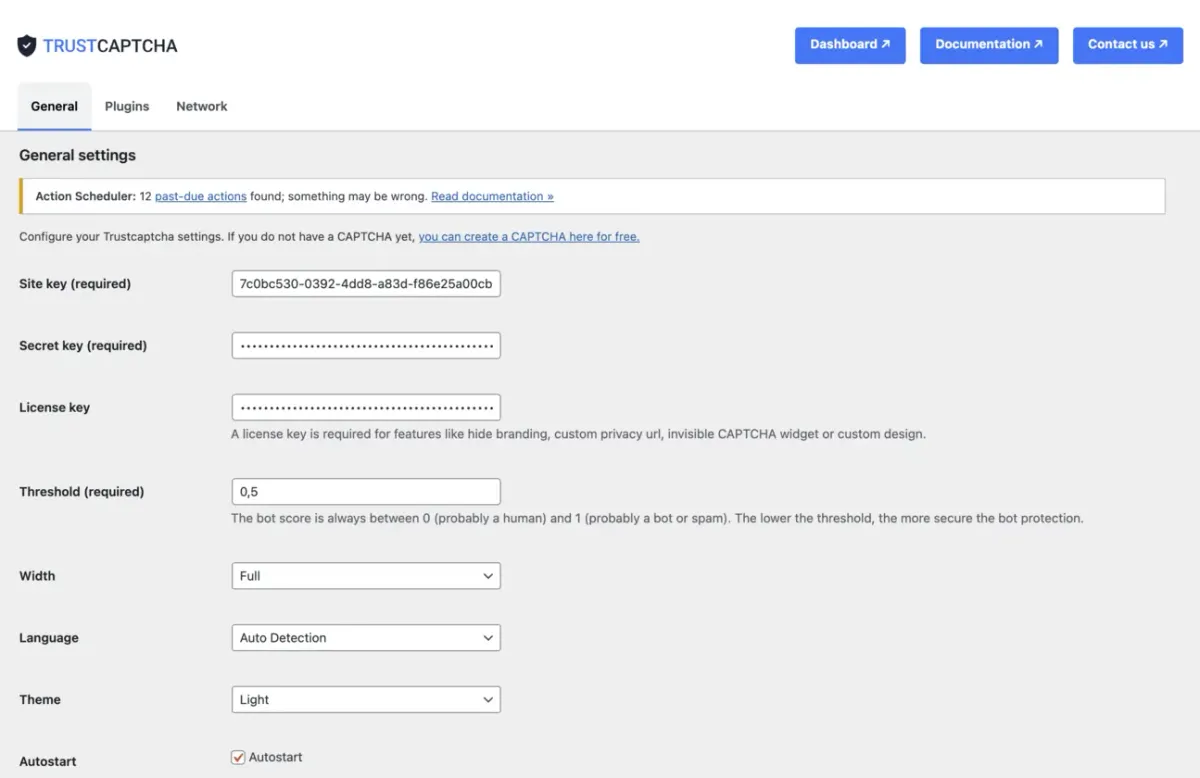
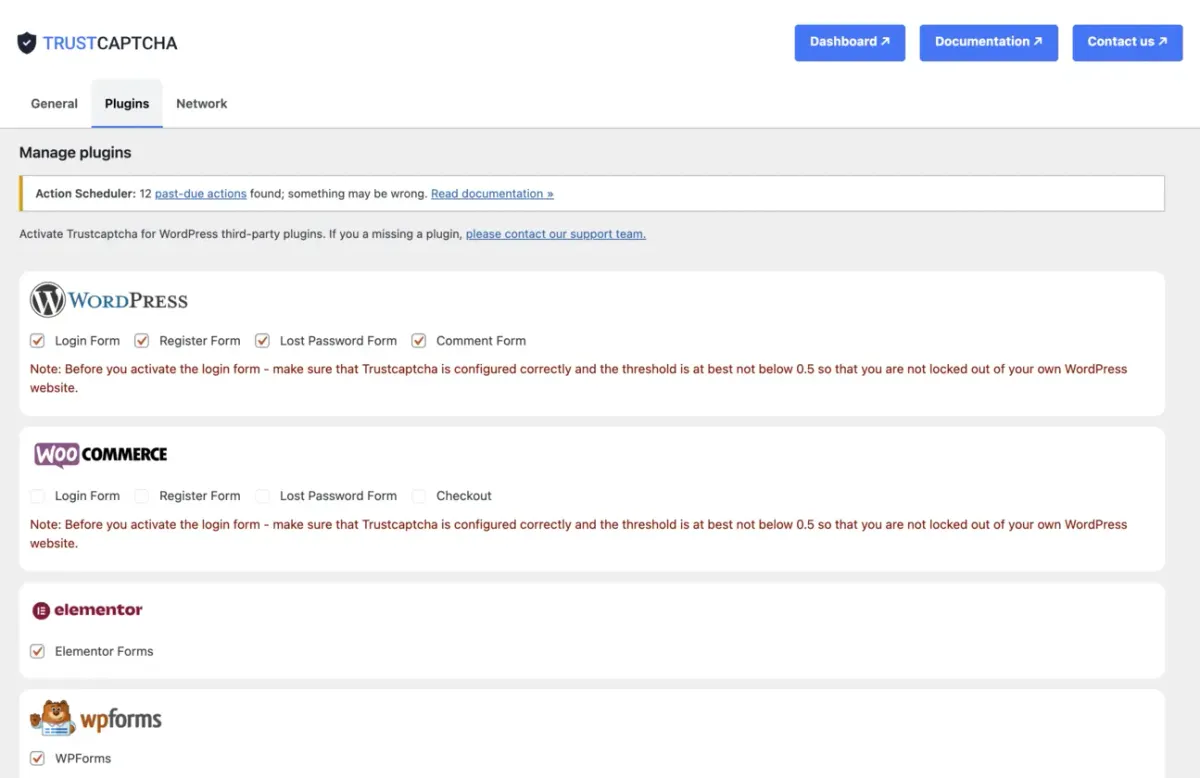
Go to Settings → TrustCaptcha and enter your site key, your API key (formerly secret key) and, if you have one, the license key. Then open the Plugins tab and activate TrustCaptcha for every WordPress plugin and form you use. You can find more information about the installation in our WordPress documentation.
4. Test your integration
TrustCaptcha is now active. Send a test request and check that it goes through.

TrustCaptcha works with all of these WordPress plugins. Contact Form 7, WPForms, Forminator, Mailchimp for WordPress, bbPress, WooCommerce and the WordPress forms get the widget automatically once you activate them in the Plugins tab. In Elementor Forms, Gravity Forms, Fluent Forms and Ninja Forms you add a TrustCaptcha field to each form you want to protect.
Contact Form 7
For a full walkthrough, see the Contact Form 7 CAPTCHA guide. TrustCaptcha protects every Contact Form 7 form on your site, and you do not need to add a form tag for it. Activate Contact Form 7 in the Plugins tab and the widget appears above the submit button of each form. When a submission fails the check, Contact Form 7 treats it as spam: the mail is not sent and the visitor sees an error message.
Elementor Forms
Elementor Forms is the form widget in Elementor Pro, and the TrustCaptcha option shows up in the Plugins tab as soon as Elementor Pro is active. After you activate it, open your form in the Elementor editor, add a new field and pick TrustCaptcha as the field type. If the check fails, Elementor shows the error at that field and does not send the form.
WPForms
TrustCaptcha works with WPForms Lite and WPForms Pro. Once WPForms is activated in the Plugins tab, the widget is placed above the submit button of your WPForms forms automatically. A submission that fails the check is stopped, and WPForms shows the error at the bottom of the form.
Gravity Forms
Gravity Forms gets its own TrustCaptcha field. Activate Gravity Forms in the Plugins tab, open a form in the Gravity Forms editor and add the TrustCaptcha field from the Advanced Fields group. Only forms that contain the field are checked, so you decide form by form. On multi-page forms the check runs when the visitor submits the last page.
Fluent Forms
In Fluent Forms you add TrustCaptcha as an element. Activate Fluent Forms in the Plugins tab, open your form in the Fluent Forms editor and drag the TrustCaptcha element from the Advanced Fields sidebar into the form, ideally right above the submit button. Only forms that contain the element are checked.
Forminator
TrustCaptcha protects Forminator forms automatically. Activate Forminator in the Plugins tab and your Forminator forms get the widget, with no field to place.
Ninja Forms
In Ninja Forms you add TrustCaptcha as a field. Activate Ninja Forms in the Plugins tab, open the form, add a new field and pick TrustCaptcha from the Misc Fields. This also works for multi-step forms built with the Ninja Forms Multi Step add-on.
Mailchimp for WordPress
Signup forms from the Mailchimp for WordPress plugin (MC4WP) are protected automatically once you activate it in the Plugins tab. That way bots cannot fill your newsletter list with fake addresses through the form.
WooCommerce
WooCommerce has four forms you can protect separately in the Plugins tab: login, registration, lost password and checkout. On the checkout the widget sits above the Place order button, and if the check fails, WooCommerce shows an error notice and the order is not placed. Bots that test stolen card numbers come in through the checkout, so it is the first shop form to protect.
bbPress
On bbPress forums, TrustCaptcha protects two forms: new topics and replies. Activate them in the Plugins tab and the widget is added automatically, so every new topic and reply has to pass the check before it is posted.
WordPress comments and registration
WordPress’s own forms are in the Plugins tab too: comments, login, registration and lost password. Activate the ones you use and the widget is added automatically. If the WooCommerce login is active, the plugin turns off the check on the WordPress login, so customers are not checked twice.
Replace reCAPTCHA on WordPress
Moving a WordPress site from reCAPTCHA to TrustCaptcha takes the steps above plus some cleanup. Set up TrustCaptcha first, activate it for the same forms reCAPTCHA protects today and test each of them. Then remove reCAPTCHA: deactivate the reCAPTCHA plugin, or delete the reCAPTCHA keys in your form plugin’s settings. If your Elementor forms use a reCAPTCHA field, replace it with the TrustCaptcha field. If a reCAPTCHA plugin also covers your WooCommerce login or checkout, switch it off there as well, so customers are not checked twice.
Once reCAPTCHA is gone, Google’s script no longer loads on your pages. TrustCaptcha sets no cookies and processes data in EU data centers. Your privacy policy probably still names reCAPTCHA; for TrustCaptcha, our documentation has a sample text you can start from. This is not legal advice, so check the wording with your data protection officer.
FAQs
Which WordPress and PHP versions are supported?
Do I need a separate CAPTCHA for every form or page?
Can I use the same CAPTCHA on multiple domains (e.g., staging and production)?
What is the threshold setting, and what value should I use?
TrustCaptcha does not show up in my form. What should I check first?
My users are blocked too often. How can I reduce false positives?
TrustCaptcha blocks spam and bots, not customers. No puzzles, GDPR-compliant, EU-hosted.


Protect your WordPress application with TrustCaptcha in just a few steps!
- EU-hosted & GDPR-compliant
- No puzzles
- Try free for 14 days