


Groovy CAPTCHA Integration
Protect the forms and logins of your Groovy application with a Groovy CAPTCHA. TrustCaptcha checks each request so you can decide what to allow, block or review. EU-hosted and GDPR-compliant, with no image puzzles.
Quickstart
How the integration works
1. Create a CAPTCHA
Create a user account or log in with an existing one. Then create a new CAPTCHA or pick an existing one. If you want to try TrustCaptcha first, every plan comes with a 14-day free trial.
The CAPTCHA overview page shows your site key and license key, and you create your API key there. Add your website’s domains to the authorized domains in the CAPTCHA security rules so they can use your CAPTCHA.
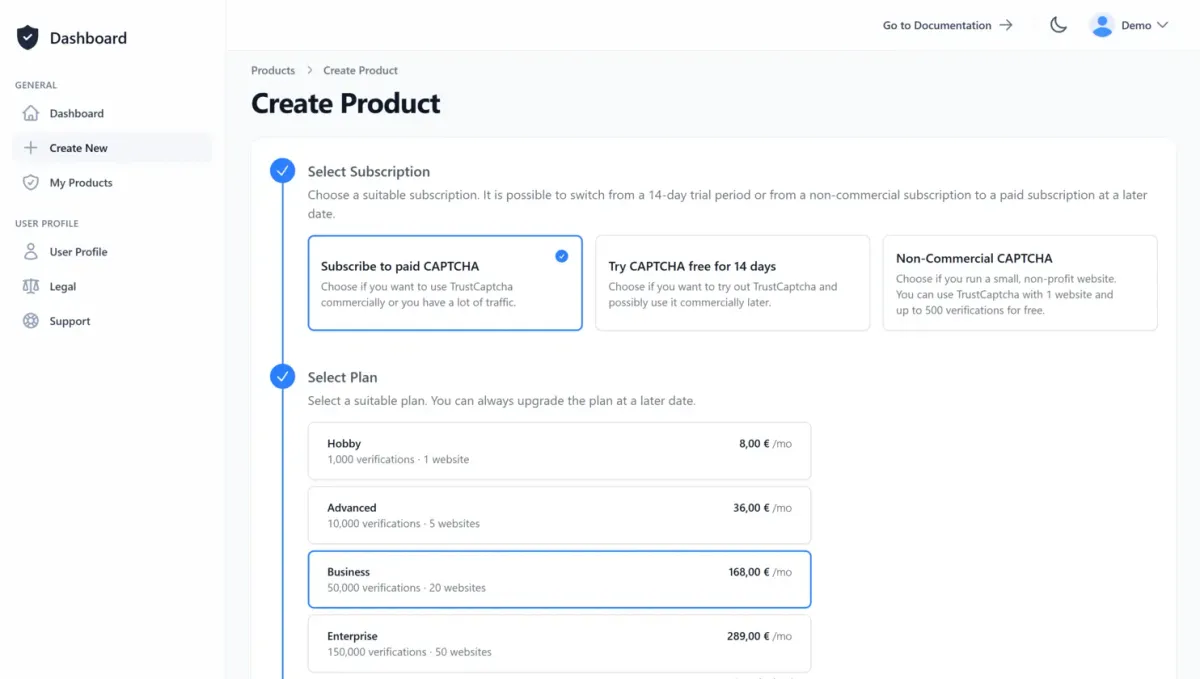
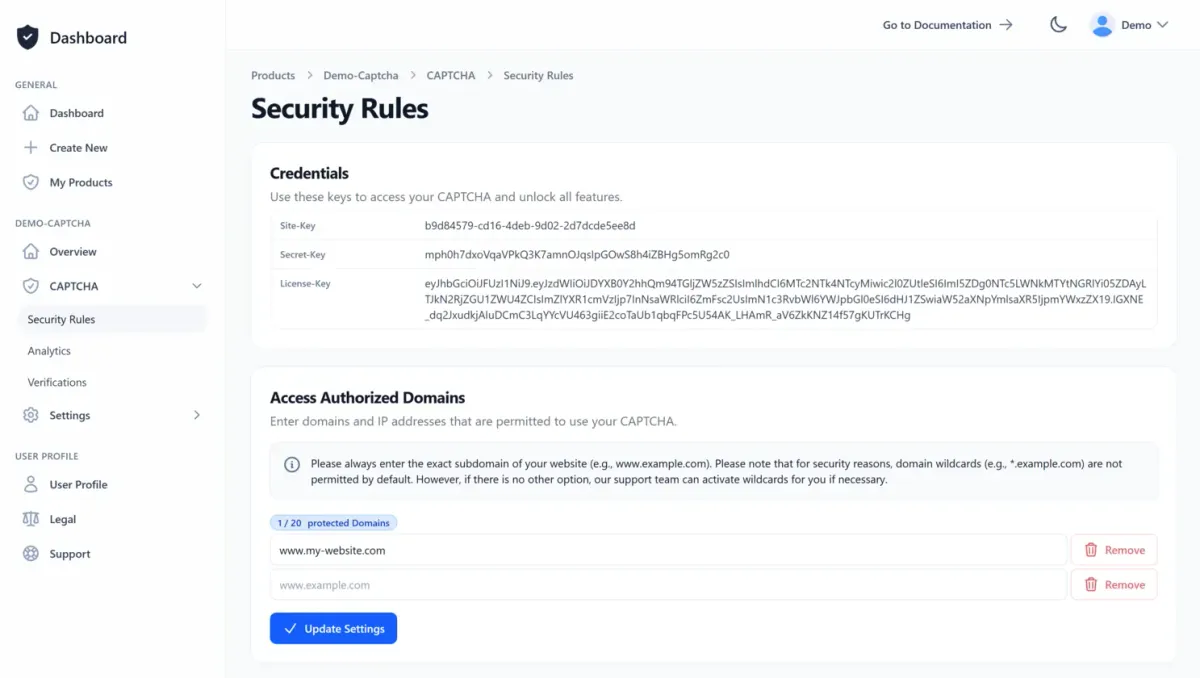
2. Integrate the CAPTCHA widget into your frontend
Integrate the CAPTCHA widget into your website or app. The CAPTCHA widget guide in our documentation has step-by-step instructions.
Read the documentation
The CAPTCHA widget will then be displayed on your website or app:

Pre-built frontend integrations
Our pre-built frontend integrations add the CAPTCHA widget to your website or application. If there is none for your frontend technology yet, your developers can integrate the widget themselves using our documentation or ask our support team for a pre-built integration.

;}.cls-3{fill:%2333c6f4;}.cls-4{fill:%231b447e;}.cls-5{fill:%23fff;}.cls-6{stroke:%23221e1f;stroke-miterlimit:10;stroke-width:7.16px;}%3c/style%3e%3cclipPath%20id='clip-path'%20transform='translate(1.72)'%3e%3ccircle%20class='cls-1'%20cx='119.73'%20cy='119.73'%20r='116.15'/%3e%3c/clipPath%3e%3c/defs%3e%3cg%20id='Layer_2'%20data-name='Layer%202'%3e%3cg%20id='Layer_1'%20data-name='Layer%201'%3e%3cg%20class='cls-2'%3e%3ccircle%20class='cls-3'%20cx='121.45'%20cy='119.73'%20r='116.15'/%3e%3cpath%20class='cls-4'%20d='M239.32,167.79c-53.41-24-108.37-91.46-113-94.55s-10.84.77-10.84.77c-3.87-6.19-10.06.77-10.06.77C76.77,123.55.14,170.11.14,170.11S36.94,237.79,122,237.79C208.48,237.79,239.32,167.79,239.32,167.79Z'%20transform='translate(1.72)'/%3e%3cpath%20class='cls-5'%20d='M67.48,116.58s15.48-7,12.38,4.65-15.48,28.64-11.61,29.41S83,140.58,86.06,142.12s5.42.78,3.87,6.2-3.1,9.29,0,9.29,5.42-7,9.29-13.94,10.06-3.87,12.38-1.55,9.29,15.49,14.71,13.94,8.51-8.52,6.19-24,1.55-20.12,1.55-20.12,4.64-2.32,13.16,8.51,24,27.09,26.31,26.32-10.83-17.8-7.74-19.35,15.48,2.32,21.68,7.74c0,0,2.12,8.87,2.12.36L126.31,73.24,115.47,74l-10.06.77S80.64,111.94,67.48,116.58Z'%20transform='translate(1.72)'/%3e%3cpath%20class='cls-6'%20d='M239.32,170.11c-53.41-24-108.37-93.78-113-96.87s-10.84.77-10.84.77c-3.87-6.19-10.06.77-10.06.77C76.77,123.55.14,170.11.14,170.11'%20transform='translate(1.72)'/%3e%3c/g%3e%3ccircle%20class='cls-6'%20cx='121.45'%20cy='119.73'%20r='116.15'/%3e%3c/g%3e%3c/g%3e%3c/svg%3e)


'/%3e%3c/svg%3e)


3. Validate the CAPTCHA result in your backend
The following steps show how a Groovy backend fetches the CAPTCHA verification result from our server and decides what to do with it. For the full instructions, read the CAPTCHA integration guide for Groovy in our documentation.
Read the documentation
First, add our TrustCaptcha dependency for Groovy:
<dependency>
  <groupId>com.trustcomponent</groupId>
  <artifactId>trustcaptcha</artifactId>
  <version>3.0.0</version>
</dependency>
Fetch the verification result from our server with the verification token and your API key:
// Retrieving the verification result
VerificationResult verificationResult
try {
  verificationResult = TrustCaptcha.getVerificationResult("<your_api_key>", "<verification_token_from_your_client>")
} catch (CaptchaFailureException e) {
  // Fetch verification result failed - handle error
}
Based on the verification result and your own requirements, decide how to proceed:
// Act on the verification result
if (!verificationResult.isVerificationPassed() || verificationResult.getScore() > 0.5) {
  // Verification failed or bot score > 0.5 - possible automated request
}
Need detailed information about the Groovy CAPTCHA integration?
Our Groovy CAPTCHA integration guide has the detailed instructions, and our CAPTCHA samples repository on GitHub has a complete integration example.
Other backend technology instead of Groovy?
If you run something other than Groovy on your server, or have several backends, pick a different integration here. If we have no pre-built integration for your backend technology yet, your developers can integrate the CAPTCHA verification themselves using our documentation or ask our support team for a pre-built integration.


4. Test your integration
TrustCaptcha is now active. Send a test request and check that it goes through.

FAQs
How does a Groovy CAPTCHA check work?
Can I use it in Grails, Micronaut or Spring Boot?
Where should I keep the API key in a Groovy app?
Which exceptions should I catch?
Is TrustCaptcha GDPR-compliant for EU deployments?
Can I customize the look and feel of TrustCaptcha?
How does TrustCaptcha keep bots out without hurting user experience?
TrustCaptcha blocks spam and bots, not customers. No puzzles, GDPR-compliant, EU-hosted.


Protect your Groovy application with TrustCaptcha in just a few steps!
- EU-hosted & GDPR-compliant
- No puzzles
- Try free for 14 days